
In managing finances, taxes, or business compliance, the first thing most people ask is, What is the difference between a CPA and an accountant?
In fact, the terms are commonly used interchangeably, and while this is true, they are not the same. Understanding the difference helps you select the right professional and potentially save money while avoiding legal or tax problems.
This guide explains CPA vs. Accountant in simple terms, including what they do, how they are qualified, and when to hire each.
What Is an Accountant?
An accountant is a professional that deals with managing financial records and conducting financial activities.
Common Responsibilities of an Accountant
- Bookkeeping and records management
- Preparing financial statements
- Payroll management
- Budgeting and financial tracking
- Basic Tax reporting
Education and Qualifications
- Usually holds a bachelor’s degree in accounting or finance
- May possess certifications, but they are not a requirement.
- Not licensed by a state regulatory authority
What Is a CPA?
A CPA (Certified Public Accountant) is a type of accountant that has received their state license and passed the CPA exam.
Requirements to Become a CPA
In order to become a CPA, a candidate has to:
- Complete 150 credit hours of education
- Pass the CPA Exam (considered one of the most difficult professional exams)
- Fulfill the state required experience
- Complete continuing professional education (CPE)
Common CPA Responsibilities
- Advanced tax planning
- Tax filing
- Audits and Reviews
- Client representation with the IRS
- Business Compliance Advisory
- Financial risk and forecasting management
Key Differences Between a CPA and an Accountant
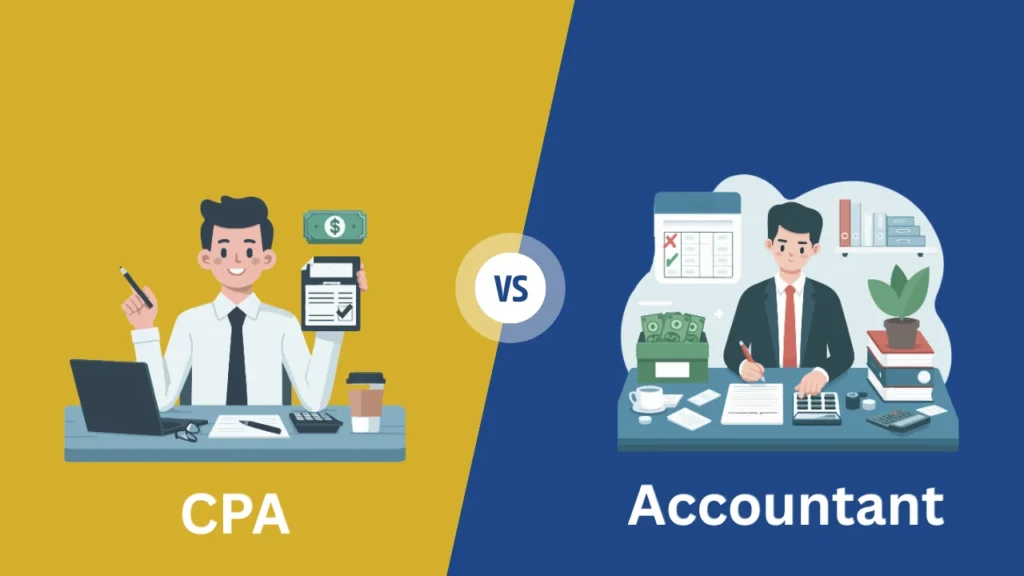
1. Scope of Services
The types of services provided is one of the biggest distinctions between an accountant and a CPA.
An accountant usually handles the business everyday financial functions. This can include keeping financial records, bookkeeping, paying employees, preparing basic financial documents, and even filling in some simple tax returns. They are good at day-to-day money management but don’t usually handle tax planning or assurance services.
In contrast, a CPA, in addition to the normal Accounting functions, does more specialized and complicated tasks. They do strategic tax planning, audits and financial reviews, complex tax filings, and business consulting. CPAs can also represent a client in front of the IRS and are in charge of making sure everything is done correctly and by the book.
2. Legal and Regulatory Authority
Accountant
- No state license is required.
- Cannot perform audits
- Cannot legally represent clients before the IRS in most cases
CPA
- Licensed and regulated by state boards
- Can sign audit reports
- Authorized to represent clients in IRS matters
- Subject to strict ethical and legal standards
3. Cost and Hiring Considerations
Accountant Costs
- Usually have a lower hourly rate
- Most appropriate for simple and repetitive tasks
- Most ideal for small businesses or individuals with basic needs
CPA Costs
- More expensive due to additional certification and experience
- More appropriate for complicated taxes, audits, or business expansion
- Often saves money in the long run through more thoughtful planning
Choosing the Right Professional for Your Needs
Hire an Accountant If You:
- Need help with Bookkeeping or Payroll?
- Have straightforward tax returns.
- Are a freelancer or small business with basic finances
- Want affordable financial record management
Hire a CPA If You:
- Own a larger or more complex business.
- Need tax strategy or compliance help
- Face an IRS audit or tax dispute
- Need audited financial statements
- Want long-term financial planning
Conclusion
The difference between a CPA and an accountant comes down to licensing, authority, and expertise.
- An accountant handles everyday financial tasks.
- A CPA offers advanced services, legal authority, and strategic insight.
If your financial needs are simple, an accountant may be enough. If accuracy, compliance, or legal responsibility matters, a CPA is the smarter choice.
Frequently Asked Questions (FAQ)
1. Is a CPA better than an accountant?
Not always. A CPA has more qualifications, but an accountant may be sufficient for basic needs.
2. Can an accountant file my taxes?
Yes, but only CPAs can represent you before the IRS if issues arise.
3. Do small businesses need a CPA?
Small businesses can start with an accountant, but often benefit from a CPA as they grow.
4. Why does a CPA cost more?
CPAs undergo extensive education, exams, licensing, and ongoing training.
5. Is CPA a legally protected title?
Yes. “CPA” can only be used by state-licensed professionals.