Starting a new venture is thrilling, taxes are not. Many new business owners find small business taxes daunting, confusing, and easy to misstep. Once you grasp a few fundamental concepts, however, taxes become a lot simpler.
This guide for first-time filers in 2026 explains the small business Tax system, the filing process, and the deductions you can claim to help you avoid pitfalls.
Understanding Small Business Taxes
The taxes imposed on small businesses vary by structure, revenue, and geographical location, as the IRS treats businesses differently.
1. Business Structures and Taxes
Your tax obligations change based on how your business is set up, as follows:
- Owner of a Sole Proprietorship
As an owner, the business’s revenue gets listed on your personal tax return (on a Schedule C attachment). Furthermore, you have to pay income tax and self-employment tax.
- Partner in a Partnership
The partnership firms pay an informational return, but the partnership’s profits get passed on to the personal tax returns of the partners.
- Member of an LLC (Limited Liability Company)
An LLC can get taxed in three ways: as a sole proprietorship, as a partnership, or as a corporation, depending on the member-managed vs. manager-managed elections.
- Shareholder of an S corporation
The profits from the corporation get passed on to the owners, but you can also divide up an owner’s salary and an owner’s distributions, which can help reduce self-employment taxes.
- Shareholder of a C-corporation
The corporation pays corporate income taxes, and the owners also get taxed on the dividends (i.e., there’s double taxation of corporate profits).
2. Taxes Imposed on Small Businesses
The most common taxes imposed on small businesses include:
- Income Tax
- Self-Employment Tax
- Payroll Taxes (if there are employees)
- Taxes on Sales of Taxable Goods/Services
- Estimated Quarterly Taxes
How to Register and File Your Business Taxes
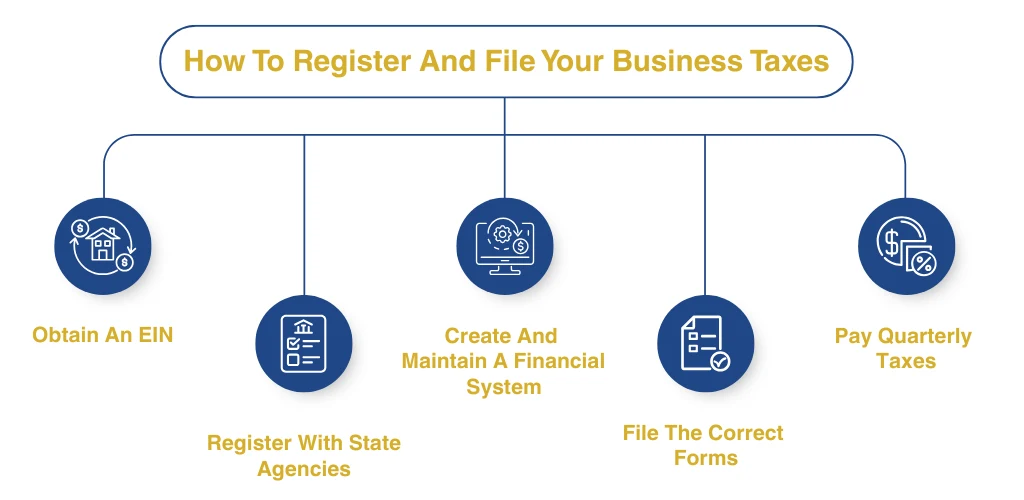
Step 1: Obtain an EIN
If your business will be hiring employees, you will need to get an Employer Identification Number (EIN) through the IRS.
Step 2: Register with State Agencies
You will need to register for the following:
- State income tax
- Sales tax permit
- Payroll tax accounts
Step 3: Create and Maintain a Financial System
You will want to invest in an accounting software package that tracks the following.
- Income
- Expense
- Payroll
- Invoices
Annual tax filings are simplified, and the risk of an Audit will be reduced with organized records.
Step 4: File the Correct Forms
The tax form your business files depends on your business structure. Using the correct form is essential to avoid penalties and delays.
- Sole Proprietors report business income and expenses on Schedule C (Form 1040), which is filed along with their personal tax return.
- Partnerships must file Form 1065 (U.S.A. Return of Partnership Income). The partnership itself does not pay income tax, but each partner receives a Schedule K-1 showing their share of profits or losses to report on their personal return.
- S Corporations file Form 1120-S. Similar to partnerships, income passes through to shareholders, who receive a Schedule K-1.
- C Corporations file Form 1120 (U.S. Corporation Income Tax Return) and pay taxes at the corporate level.
- If your business has employees, you’ll also file payroll-related forms such as Form 941 (quarterly payroll taxes) and Form W-2 for employees.
Filing the right forms on time keeps your business compliant and helps avoid IRS penalties.
Step 5: Pay Quarterly Taxes
If you expect to owe taxes, you typically must pay estimated Taxes four times per year.
Tax Deductions and Credits for Small Businesses
Deductions lower your taxable income meaning you pay less tax.
Common Deductions
- Office rent or home office expenses
- Utilities and internet
- Business travel and meals
- Marketing and advertising
- Software and subscriptions
- Professional fees (accountants, lawyers)
- Equipment and depreciation
- Employee wages and benefits
Tax Credits
Credits directly reduce your tax bill. Examples may include:
- Work Opportunity Tax Credit
- Small Business Health Care Tax Credit
- Research & Development (R&D) Credit
Common Mistakes to Avoid
- Mixing personal and business expenses
- Missing quarterly tax payments
- Poor recordkeeping
- Forgetting deductible expenses
- Misclassifying employees as contractors
- Ignoring state tax rules
These errors can lead to penalties, audits, or overpaying taxes.
Plan Ahead: Small Business Tips for Tax Time
- Set aside 25–30% of income for taxes
- Review financial reports monthly
- Keep digital copies of receipts
- Work with a tax professional
- Use payroll and accounting software
- Plan purchases before year-end to maximize Tax Deductions
Tax planning should happen all year – not just in April.
How Justworks Simplifies Small Business Taxes for Beginners
For new business owners, platforms like Justworks help reduce tax stress by combining HR, payroll, and compliance tools.
Key Benefits
- Automatic payroll tax calculations and filings
- W-2 and 1099 generation
- Benefits administration
- Compliance support
- Employee onboarding tools
Instead of juggling multiple systems, small businesses can manage payroll and tax-related processes in one place, helping reduce errors and save time.
Conclusion
Business taxes don’t have to be frightening. Obtaining an understanding of your business structure, organized recordkeeping, and knowing which expenses to claim puts you ahead of your peers. The objectives are consistency, planning in advance, and employing quality resources.
With the right infrastructures, tax season becomes a non-issue.
FAQs
1. Do all small businesses need to pay quarterly taxes?
Most do if they expect to owe taxes. Not paying can lead to penalties.
2. What is self-employment tax?
It covers Social Security and Medicare for business owners.
3. Can I deduct my home office?
Yes, if it’s used regularly and exclusively for business.
4. Should I hire an accountant?
Highly recommended, especially in your first years.
5. What happens if I miss a tax deadline?
You may face penalties and interest charges.
6. How long should I keep tax records?
Generally, at least 3-7 years.
7. What’s the easiest way to manage small business taxes?
Use accounting software, stay organized, and consider Payroll platforms like Justworks.