
An accounting career in America is changing. Accountants used to be seen as compliance specialists. Their main jobs included keeping up with company finances, auditing records, and reporting to the government. While these jobs are still necessary today, being able to do them isn’t the most valuable skill an Accountant can have anymore.
Many client demands are actually making accountants do more than just reporting numbers. Modern accountants have to provide consultative services instead of just doing descriptive reporting. Accountants need to provide analysis services to help client businesses decide better, achieve better, and plan better. Changes in technology, client demands, and the rapid changes in the business world make these types of changes necessary for the Accounting profession.
We need to define the current accounting paradigm some more. Here are some ways firms can continue to be relevant in the industry.
What Is Compliance vs. Advisory?
Originally, the accounting profession’s integrity relied on compliance Services, which include the following:
- Drafting financial statements
- Tax filings
- Regulatory compliance
- Audits
- Recordkeeping
While these are necessary (and often required by law), they are usually backward-looking and focus on what has already happened.
In contrast, advisory services focus on the future and include the following:
- Financial planning and forecasting
- Business strategy
- Risk management
- Cashflow management
- Performance analysis
At the most basic level, compliance responds to the question, “Are we doing things by the book?”
While advisory responds to “What else can we do to evolve and advance?”
Why the Shift Is Happening
1. Automation Is Reducing Compliance Work
AI and Automation Tools have cut down time spent on everyday accounting duties. Some of the things accounting software can do include:
- Automatic categorization of transactions
- Bank account reconciliation
- Report generation
- Anomaly detection
Consequently, many compliance-related assignments can be completed faster and with less manpower. This places less value on entry-level accounting services for clients.
Accountants have to evolve if they want to keep their places in the industry. They can no longer perform duties that can be done by machines. Instead, they need to focus on the things that require human thinking.
2. Clients Expect More Than Just Reports
Businesses nowadays want more than just financial statements; they want analysis.
Clients want to know:
- What are the numbers telling us?
- How can we improve profits?
- Where should we invest?
- What risks should we consider?
As a result, accountants are moving beyond their traditional roles as record-keepers and becoming business consultants.
3. Increased Business Complexity
More than ever, the USA business environment is complex. Companies must contend with:
- Technology that rapidly evolves
- Competition that crosses borders
- Changing regulations
- Economic unpredictability
Within this environment, business owners need insight and direction, not just compliance. Accountants, more than anyone, understand the financial pulse of the organization and can provide that insight.
4. Higher Profit Margins in Advisory Services
Services pertaining to compliance have a high level of competition, which has caused prices to become more resistant to change.
In contrast, advisory services:
- Provide greater value, which increases
- Positively impacts the demand with respect to pricing
- Foster relationships with clients that will last beyond the short term.
The revenue and profit of firms that have moved to an advisory services model have considerably improved.
Key Areas of Advisory Services
1. Financial Planning & Forecasting
Accountants assist companies to:
- Develop budgets
- Predict future income and expenditure
- Plan for expansion
This allows clients to proactively manage their finances without dealing with unpleasant financial surprises.
2. Cash Flow Management
Businesses face a lot of challenges, but Cash Flow problems are usually at the top of the list.
Business advisory services can help with:
- Tracking cash in and cash out
- Assessing liquidity risks
- Optimizing payment cycles
Effective cash flow management can mean the difference between staying in business and going bankrupt.
3. Business Strategy
Accountants can touch upon:
- Potential areas for reducing costs
- Setting prices
- Planning for future growth
They balance business strategies and finances through data analysis.
4. Tax Planning (Not Just Filing)
For advisory-focused accountants, tax filing is just one piece of the puzzle. They also:
- Craft strategies that save taxes.
- Spot deductions and credits that save tax
- Plan tax-affecting transactions to reduce tax incurred.
When accountants take this proactive approach, the value they bring is exponentially greater than just the value of compliance work.
5. Risk Management
Advisory services entail recognizing and handling the following risks:
- Financial risk
- Operational inefficiencies
- Compliance gaps
This enables businesses to avoid making costly errors.
How Technology Is Enabling the Shift
Technology allows firms to improve advisory services rather than simply decrease compliance.
Today’s technology allows the following:
- Financial data in real time
- Analytics that are more advanced
- Predictive understanding
- Visual dashboards
Technology allows data to be accurate and timely, meaning accountants can provide advice that is both quicker and more impactful.
Accounting firms that want to improve their advisory services will find that cloud-based Accounting Solutions, data analytic technology, and AI-driven insights are necessary.
Skills Accountants Need to Develop
To thrive in this new environment, accountants need to have a mindset that encompasses skills beyond the rigorous technical know-how.
1. Analytical Skills
Valuable insights are given by data interpretation and trend identification.
2. Excellent Communication
Accountants need to simplify and clarify complex information to their clients.
3. Business Knowledge
It assists accountants in giving practical and applicable advice.
4. Tech Savviness
It’s a must to be familiar with Accounting Tools and data analytics.
5. Trust
Building adviser services depends on trust. Success is from client closeness.
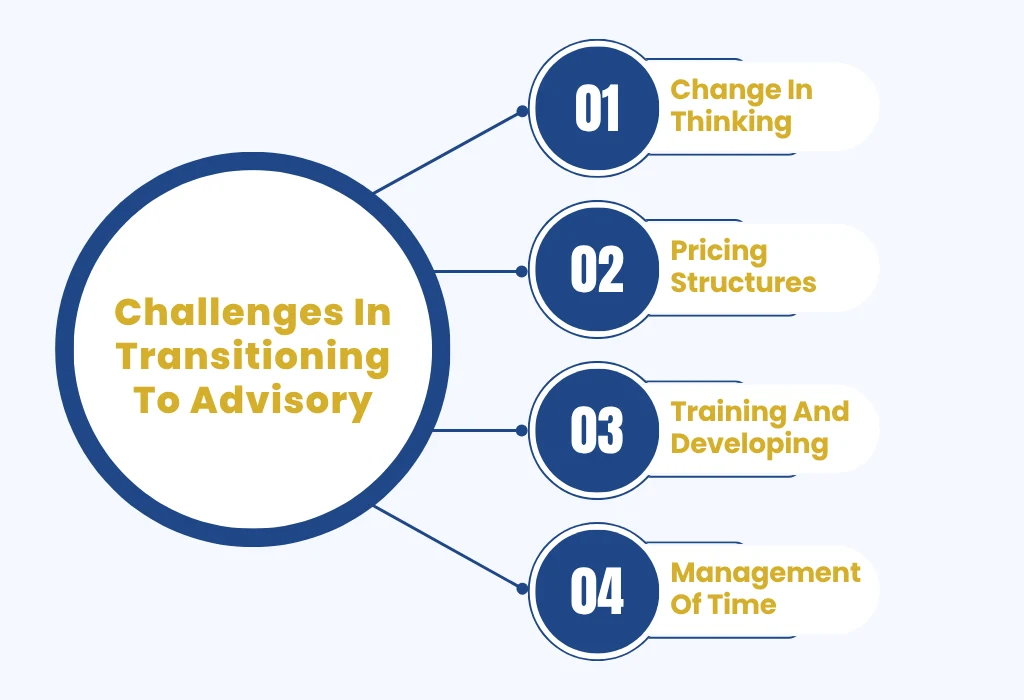
Challenges in Transitioning to Advisory
The proposed changes bring potential opportunities with significant challenges as well.
1. Change in Thinking
Most accountants primary concerns have always been accuracy and compliance. Being an advisor requires a shift to more defensive and tactical thinking.
2. Pricing Structures
Advisory services typically require more value-based pricing as opposed to hourly billing. Which is a challenge to do in the beginning.
3. Training and Developing
Companies have to devote resources to the training and developing of their employees in advice.
4. Management of Time
It can be difficult to balance compliance and advisory Services, particularly during busy seasons like tax filing.
How Firms Can Start the Transition
1. Advisory Opportunities Uncovered Through Analysis
Determining options for adding value beyond being a numbers/legal checker is the first step. Start with current clients.
2. Insights Driven by Existing Financial Data
Utilize financial data that is already available for insights and recommendations.
3. Take a Gradual Approach
Begin with advisory services that are less complex – imagine cash flow analysis, budgeting, and so on.
4. Technology Upgrades
The right tools that offer automation and real-time insights are an upgrade.
5. Client Education Initiative
The advisory services for your clients are very new. Value and benefits and the potential for their business should be explained.
The Future of Accounting in the USA
Moving from compliance to advisory services is not just a new trend. It is what the future of the profession is going to be.
Over the upcoming years:
- Advisory services will become the main game changer.
- Compliance services will be completely automated.
- Accountants will become strategic partners within the businesses they service.
Firms that embrace these changes will be able to succeed. The other firms that resist will slowly go out of business.
Conclusion
Accountant jobs in the USA have started to channel away from simply crunching numbers. Compliance work is crucial to the job, though in the current market it is insufficient to set one firm apart from the others.
With the adoption of advisory Services, paired with tech, and perhaps new skill training, accountants will not only offer more in-depth services to their clients but also have more equity with the firm.
FAQs
1. What is the difference between compliance and advisory services in accounting?
While compliance services consider purely legal and regulatory requirements, such as tax filings, audits, and Bookkeeping, advisory services consider much more and provide clients with strategies, financial insights, and business advice for growth.
2. Why is the accounting industry shifting toward advisory services?
The primary factor driving this change is automation, which is minimizing the amount of manual compliance work, combined with an increase in client requests for more strategic thinking. Today’s companies desire accountants who contribute to business decision-making, rather than just reporting.
3. Are compliance services becoming obsolete?
In compliance, yes. There is no doubt that services offered in compliance are still legal requirements and will continue to be so. They are becoming more automated and, as a result, are less profitable. This is the reason firms are moving into advisory services for more lucrative work.
4. What types of advisory services do accountants offer?
Advisory services can include forecasting, managing cash flow, tax planning, business strategy, and risk management. All of these serve the purpose of helping businesses to improve decision-making and enhance overall performance.
5. What skills are required to provide advisory services?
To provide advisory services, accountants require strong analytical skills, excellent communication skills, comprehension of business principles, and familiarity with current accounting technologies.
6. How can small accounting firms transition to advisory services?
Firms should start by understanding their clients, analyzing available financial data, providing more basic advisory services such as budgeting, and then expanding their service offerings.
7. How does advisory improve client relationships?
Advisory services provide stronger relationships as accountants become trusted partners. Instead of meeting just during Tax Season, firms hold regular discussions with clients and help them succeed over time.