
Managing finances gets more difficult for businesses as they grow. In an effort to remain efficient and compliant, many companies adopt outsourced accounting solutions or virtual accounting. While these descriptions may seem to overlap, they are not interchangeable.
By grasping the distinctions between virtual and outsourced accounting, you can select the apt financial assistance your business requires. I’ll explain.
What Is Virtual Accounting?
Virtual accounting means accounting services done through cloud-based software and other digital products. You can still have an accountant without having an accountant in your office.
Accountants usually work through email and video calls. They use cloud accounting systems like QuickBooks or Xero.
Their services include:
- Recording and organizing data
- Reconciling bank and credit card transactions
- Tracking expenses and invoicing
- Reporting financially
- Coordinating payroll
Virtual accounting acts best for companies that need to access their data in real time and that do not want to employ full-time people.
What Is Outsourced Accounting?
Outsourced accounting is when you get another accounting company to handle some or all of your accounting and finance functions. This could be anything from simple bookkeeping to high-level financial management.
Outsourced accounting typically provides you with a complete team, comprising bookkeepers, an accountant, and a financial advisor. This team will all support your business.
Some of the more common accounting services are
- Full bookkeeping cycles
- Accounts payable and receivable
- Payroll management
- Tax compliance and preparation
- Analysis and financial planning (FP&A)
- Advisory services at the CFO level
This is a good business model for companies needing flexible, end-to-end financial management.
Key Differences Between Virtual and Outsourced Accounting
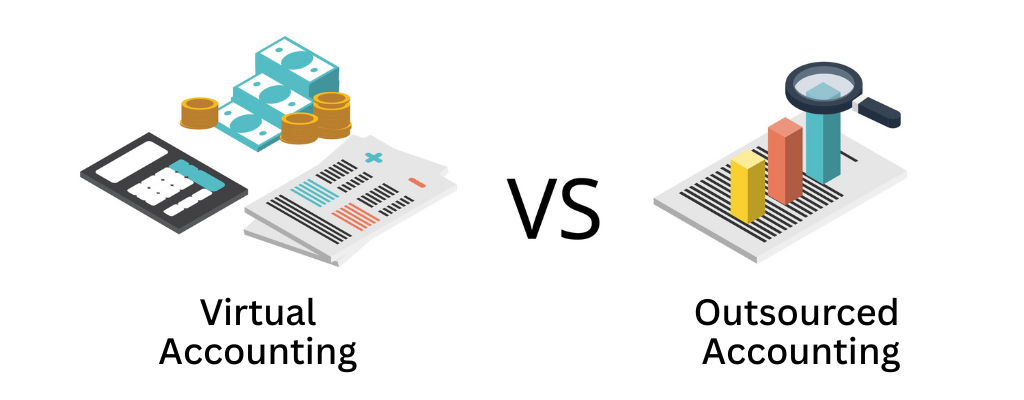
Both models remove the need for in-house accounting staff. However, these models differ in the ways they function. Here, I will break down the key differences between the models.
1. Services Provided
Virtual Accounting: Usually handled internally via local or domestic accounting professionals. Since they fall under the same jurisdiction and regulations as your firm, compliance is more simplified.
Outsourced Accounting: Typically, these partnerships begin with offshore employees and the firm conducting assignments internationally. Although these partnerships can be more economical, the firm bears the time zone, communication, and regulation risk.
2. Business Relationship
Virtual Accounting: It is pretty much the same as having a local accounting professional, but they just work remotely. There is a great deal of communication, and you have a great deal of access to the remote accounting services.
Outsourced Accounting: Usually, the relationships are transactional in nature. You pass off the accounting and get work in return, but there isn’t much engagement above and beyond that.
3. Services Range
Virtual Accounting: This is usually very focused and covers bookkeeping, reconciliations, and business-specific reporting and advisory services.
Outsourced Accounting: Typically more comprehensive and can range from basic data input to more advanced services like payroll, tax returns, audit preparation, and even outsourced CFO services.
4. Technology and Tools
Virtual Accounting: Most use cloud-based platforms where you and your accountant see the same information. There are also a lot of automation tools, which makes everything quick and easy.
Outsourced Accounting: They might use cloud-based tools, but you won’t be able to see any of it. A lot of the time, the outsourcing company just uses their own tools, which makes it harder for you to understand what’s happening every day.
5. Cost Structure
Virtual Accounting: Most often, it is cheaper than hiring your own staff, but it can cost more than outsourced services because you are paying for someone in your own country and for a little more attention to detail.
Outsourced Accounting: Usually it is the cheapest, especially if the people doing it are in a different country. But this can also mean that they won’t be as quick to respond to your questions or the services they offer you won’t be as specialized.
6. Compliance and Risk Management
Virtual Accounting: Since virtual accountants are often local, they understand the country’s accounting rules, tax laws, and regulations more than others. Compliance is less risky.
Outsourced Accounting: You really need to check the firm to see if they understand your country’s rules. If they don’t, you could be at risk legally or have issues when it comes to taxes.
7. Customization and Personalization
Virtual Accounting: They tend to be able to customize the service to be more of what you need, compared to most firms. Virtual accountants tend to be able to provide more services, like acting as a business advisor and helping you understand and make important decisions based on the financial statements.
Outsourced Accounting: Usually adheres to a set, standardized, and process-driven approach aimed at maximizing efficiency across diverse customers. Customization might be restricted.
Advantages of Virtual and Outsourced Accounting
Virtual Accounting
- Real-time access to financial data.
- Personalized service with stronger communication.
- Better alignment with local compliance needs.
- Flexibility to scale as your business grows.
Outsourced Accounting
- Significant cost savings compared to in-house or virtual options.
- Ability to offload large volumes of work.
- Access to a wide range of services, from bookkeeping to CFO support.
- Time savings, allowing business leaders to focus on growth.
Which Option Is Right for Your Business?
The choice between virtual and outsourced accounting depends on your company’s size, budget, and goals.
- Choose Virtual Accounting if:
You want ongoing collaboration, transparency, and tailored advice while keeping compliance risks low. This option is ideal for businesses that value real-time insights and need a financial partner rather than just a service provider. - Choose Outsourced Accounting if:
You’re focused primarily on cutting costs and offloading routine tasks. If your business has high-volume, repetitive accounting needs and you don’t require daily visibility or advisory, outsourcing could be the most efficient solution.
Conclusion
While virtual and outsourced accounting share similarities, they serve different purposes. Virtual accounting is about collaboration, transparency, and real-time insights—essentially giving you the benefits of an in-house accountant without the overhead. Outsourced accounting, on the other hand, is about efficiency and cost savings, often achieved by delegating work to offshore providers.
Ultimately, the right choice depends on whether your priority is strategic financial partnership (virtual accounting) or streamlined cost-effective processes (outsourced accounting). By understanding the key differences, business owners can make an informed decision that supports both their financial health and long-term growth.
FAQs
1. Is virtual accounting the same as outsourcing?
No. Virtual accounting focuses on remote bookkeeping, while outsourced accounting covers broader financial services and strategy.
2. Is outsourced accounting more expensive?
It can cost more upfront, but it often saves money long-term by reducing errors, improving compliance, and eliminating in-house hiring costs.
3. Can small businesses use outsourced accounting?
Yes. Many outsourced firms offer flexible packages tailored to small and medium-sized businesses.
4. Are virtual accountants secure?
Yes, when they use secure cloud-based accounting software with proper data protection protocols.
5. Can I switch from virtual to outsourced accounting later?
Absolutely. Many businesses start with virtual accounting and upgrade to outsourced accounting as their needs grow.