In the USA, end-of-year Payroll Processes give payroll teams and business owners significant challenges and opportunities. Completing payroll accurately allows proper payroll tax reporting, compliance, and business financial recordkeeping for the year. Many businesses, however, are pressured into completing Payroll in a rush, resulting in expensive mistakes, fines, and delays.
Preparing and completing payroll in a timely manner at the end of the year is essential. In this article, we present a year-end payroll checklist guide for compliance and organizational purposes for USA businesses.
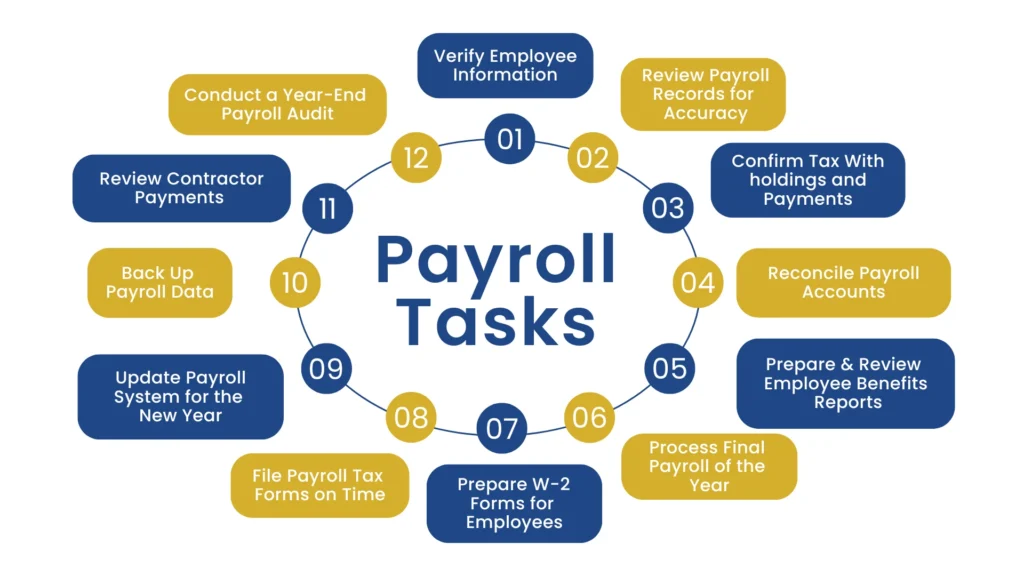
12 Key Payroll Tasks Every USA Business Must Complete at Year-End
1. Verify Employee Information
Before generating year-end payroll reports, it is crucial to examine the details of each employee. Even the slightest mistake can create problems when submitting tax documents.
Please verify the following:
- Employee names (according to Social Security records)
- Social Security Number (SSN)
- Address
- Withholding tax details
- Employee status (active or terminated)
Data inaccuracies can complicate the submission of tax documents, especially concerning the W-2 tax form.
2. Review Payroll Records for Accuracy
Next, conduct a comprehensive review of the payroll records for the entire year and take note of the discrepancies before the final reporting.
Consider reviewing the following:
- Wages
- Overtime
- Bonus and commission payments
- Employee benefit payments
- Payroll deduction
Ensure all payroll runs are accurately captured, and there are no missing or overpaid disbursements.
3. Confirm Tax Withholdings and Payments
Before the year is closed, all payroll taxes must be accurate and updated. Businesses must ensure all federal, state, and local Payroll Taxes have been withheld and paid correctly.
Key payroll taxes include:
- Federal income tax
- Social Security tax
- Medicare tax
- State payroll taxes (if any)
You must ensure all deposits to the Internal Revenue Service (IRS) and all quarterly filings like Form 941 are completed.
4. Reconcile Payroll Accounts
Ensuring that payroll records are aligned with financial statements is called Payroll Reconciliation. This process aids businesses by eliminating mistakes in reporting or compliance.
Review these accounts:
- Accounts relating to payroll expenses
- Accounts relating to payroll liabilities
- Accounts relating to tax payables
- Accounts relating to benefits and deductions
Discrepancies should be settled prior to closing the books for the year.
5. Prepare and Review Employee Benefits Reporting
It’s also important to ensure accurate reporting of employee benefits at the end of the year. Employee benefits affect taxable income and reporting obligations.
Benefits to consider include:
- Health insurance
- 401(k) retirement plans
- Flexible Spending Accounts (FSA)
- Health Savings Accounts (HSA)
- Employer-sponsored benefits.
Make sure these employee benefits are recorded accurately in the payroll system.
6. Process Final Payroll of the Year
The last payroll is very important because it determines how employee tax documents are processed, as well as year-end reporting. Things to do before the last payroll is processed:
- Ensure all employee hours are captured.
- Add in bonuses or adjustments.
- Process any reimbursements
- Apply any final tax calculations.
When payroll is done correctly, it can be reported accurately in the year-end documents.
7. Prepare W-2 Forms for Employees
Among the numerous tasks involved in year-end payroll, one of the most critical is the completion of Form W-2, which captures the employees’ total income and taxes withheld.
Employers are required to:
- Create W-2 forms for all employees
- Review all information for accuracy.
- Distribute W-2 copies to employees
- Send a W-2 copy to the IRS and the Social Security Administration
W-2 forms must be sent to employees by January 31.
8. File Payroll Tax Forms on Time
The deadlines for year-end payroll filing are strict, and the penalties for failing to meet them can be significant. As a result, businesses must be careful to ensure that all forms are filed prior to the deadlines.
Some of the most significant forms that must be filed include the following:
- Form W-2
- Form W-3
- Form 940 (Federal Unemployment Tax)
- The state payroll tax report
By establishing and maintaining a payroll calendar, a business can avoid missing any of the filing deadlines.
9. Update Payroll System for the New Year
Ensure you update your payroll system before processing payroll for the new year to account for any new tax rates and compliance changes.
These updates include:
- New tax brackets
- Updated contribution limits
- Changes in minimum wage laws
- Updated employee benefits limits
If you use payroll software, ensure system updates to process the first payroll of the year.
10. Back Up Payroll Data
Sensitive financial and employee information is included in payroll data. Businesses need to back up payroll data and securely store it at the end of the year.
- Replication of information digitally
- Protection of payroll documentation
- Ultimate protection of tax documentation
- Retention of data for a period of four years
This is for the protection of the business in the event of an Audit or a compliance review.
11. Review Contractor Payments (1099 Forms)
Numerous companies engage with independent contractors, freelancers, or consultants. Year-end means preparing Form 1099-NEC for contractors who have been paid during the year.
When preparing the forms, make sure to:
- Validate totals for payments made to contractors
- Confirm correct tax ID numbers
- Complete 1099 forms
- Submit forms prior to the cutoff
This task is crucial for companies that function with outsourced or remote teams.
12. Conduct a Year-End Payroll Audit
A final step before closing the year is to conduct a payroll audit.
Gaps that payroll audits help identify include:
- Compliance
- Payroll miscalculations
- Issues with tax filings
- Employee classification errors
This step reassures businesses that their Payroll process is accurate and compliant.
Why a Year-End Payroll Checklist Matters
A structured checklist for payroll:
- Keeps the business free from IRS fines
- Helps in tax-related recordkeeping.
- Increases the business’ financial clarity
- Reduces the time needed for taxes
- Allows the business to enter the new year with organized documentation.
A good payroll system improves trust with clients and employees for expanding businesses and Accounting Firms (such as teams providing outsourced services via KeyCMS Accounting).
FAQs
1. When do businesses need to do year-end payroll preparation?
Businesses need to do year-end payroll preparations at least one to two months before the end of the year to have enough time to do everything that needs to be done and to fix any possible mistakes.
2. What are the consequences of late filing W-2 forms?
Depending on the lateness of the submission, the Internal Revenue Service can impose fines on late submissions of W-2 forms.
3. What is the time period for keeping payroll records?
For tax and compliance reasons, most businesses should retain payroll records for at least four years.
4. Does a small business need a payroll checklist?
Yes, small businesses do need payroll checklists because they help to avoid mistakes and ensure everything is done in accordance with the tax regulations.
5. What are the end-of-year payroll forms that have to be filled out?
The most common forms that have to be filled out are the W-2, W-3, 1099-NEC, and Form 940.
6. Do payroll systems make end-of-year payroll easier?
Yes, the latest payroll systems do make it easier because everything is done automatically for you, and they can even do the tax calculations, which can make everything much easier.
7. Does a business need to check the employee classifications at the end of the year?
Yes, it can help to avoid compliance problems and getting fined.