Beginning your journey as an employer can be exhilarating – yet getting payroll right for the first time can be daunting. Legal issues, payroll software, and methods of employee payment – it’s a lot to manage. An effective payroll system does more than eliminate payroll errors; it protects you from legal fines and gives your employees confidence in your business.
This is a step-by-step process for first-time employers. It is a comprehensive Payroll System setup guide. It does not matter if you are managing payroll yourself, or if you have decided to get a Payroll Service.
10 Easy Steps to Set Up Payroll for First-Time Employers
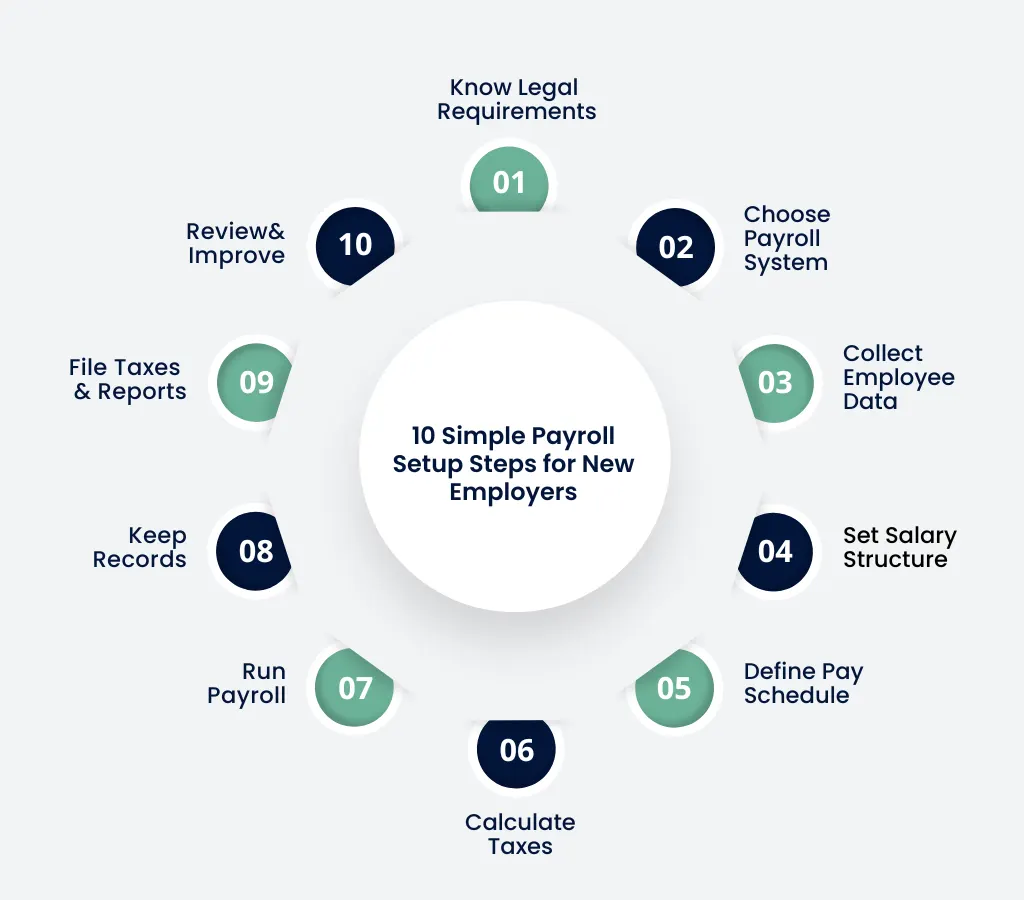
1. Understand Your Legal Responsibilities
Prior to receiving your first paycheck, it is important to learn about the laws concerning payroll that apply to your location.
This includes, but is not limited to:
- Business registration with the appropriate tax office
- Acquiring employer identification numbers
- Familiarity with labor laws, minimum wage, and tax liabilities
- Compliance with mandatory social security, provident fund, and similar contributions
Non-compliance may result in significant penalties, making this step necessary. Due to the complexity of the processes involved, many businesses opt to use professional Payroll Services.
2. Choose the Right Payroll System
A major decision you will have to make is how you want to handle payroll. There are usually three approaches:
a) Manual Payroll
You do salary, tax, and deduction calculations on spreadsheets. It is cost-effective, however, it is very error-prone.
b) Payroll Software
These tools handle wage and tax calculations and payslip generation.
c) Payroll Outsourcing
You bring on specialists to manage the entire process, including all the calculations and compliance. This is best for businesses that don’t want to spend a lot of time dealing with the intricacies.
First-time employers typically find themselves better suited to Outsourcing Payroll or opting for modern Payroll Solutions that are more effective, safer, and scalable.
3. Collect Employee Information
Employee data can streamline payroll activities. Ensure you obtain:
- The name and contact information
- Tax ID
- Banking info
- Employment contract and details of the salary structure
- Information on benefits and deductions
Payroll mistakes can be avoided if you secure and manage this data consistently.
4. Define Salary Structure
The payroll process is simplified and made more compliant because of a set salary structure. A salary usually consists of:
- Basic salary
- Allowances (housing, travel, etc.)
- Bonuses/incentives
- Deductions (tax, provident fund, insurance)
With a salary structure, there is simplicity and reliability in payroll processing.
5. Set Up a Payroll Schedule
Choose how you will pay your employees. Common options are:
- Weekly
- Bi-weekly
- Semi-monthly
- Monthly
Consistency is important. Trust and employee satisfaction improve with reliable payroll systems. Pick a system and stick with it.
6. Calculate Taxes and Deductions
Tax calculation is one of the most complicated aspects of payroll. Consider the following:
- Tax income deductions
- Contributions to social security
- Professional taxes if applicable
- Deductions for employee benefits
Tax calculation errors and the possibility of noncompliance with recent legislation can be minimized by utilizing payroll solutions or outsourcing payroll.
7. Process Payroll
Now it’s time to take that final step – paying your employees. When processing payroll you must:
- Calculate gross pay
- Make deductions and tax withholdings
- Calculate net pay
- Pay your employees by direct deposit
- Create and send pay stubs to employees
Mistakes made during payroll processing can be minimized, and time spent can be saved by utilizing payroll software or choosing to outsource payroll services.
8. Maintain Payroll Records
It is a legal requirement and a good practice to keep accurate payroll records. To do this, keep records of:
- Employee information
- Recorded history of salaries and wages
- Records of tax submissions
- Records of pay slips and payments
Without these records statements and tax filings could be made incorrectly, and financial planning could be compromised.
9. File Taxes and Compliance Reports
In connection with employees’ wages, business owners are required by law to report various payroll taxes and reports to the government. These obligations include the following:
- Tax returns (monthly or quarterly)
- Tax statements for employees
- Reports for compliance
If reports are late, the owners will incur costs. As a result, a significant number of companies use payroll outsourcing services to manage the reports and ensure compliance with the reporting deadlines.
10. Review and Optimize Your Payroll Process
Once your payroll system is operational, make sure to keep your review processes up to date. During a review, ask yourself:
- Are there a high number of inaccuracies?
- Is payroll being processed in a timely manner?
- Are there compliance requirements being met?
If you answered yes to all of those questions, then it’s time to look into better payroll solutions, or possibly payroll outsourcing.
Benefits of Using Payroll Solutions or Outsourcing
For first-time employers, doing payroll by yourself is time-consuming and can even be risky. There are several reasons why most businesses use external payroll services:
Correctness
Adjustment of payment and calculation errors are virtually eliminated with automated systems.
Notification
Payroll services are completely compliant and work with the most up-to-date tax laws and Service regulations.
Focus on Other Areas
Instead of doing payroll, you can focus on expanding your business.
Growth
Once your business increases in size and complexity payroll services will be ready to adapt to the changes.
Common Payroll Mistakes to Avoid
Mistakes happen. Some of the most common screw-ups employers make include:
- Confusing full-time vs. contracted employees
- Incorrect payroll tax calculations
- Missing payroll cut-off dates
- Failing to keep adequate payroll records
- Not tracking changes to employee records
Payroll outsourcing or reliable payroll software can help prevent these errors.
Why Choose KeyCMS Accounting for Payroll?
At KeyCMS Accounting we understand payroll goes beyond just issuing paychecks; it’s about precision, adherence to regulations, and building trust.
We provide a range of payroll services designed to meet your business needs.
- Full payroll processing
- Payroll taxes calculated and submitted
- Pay stub generation
- Management of compliance regarding payroll
- Tailored payroll services to fit your business needs
We provide peace of mind and streamlined processes through our outsourcing payroll services, whether you are a new business or a more established, expanding enterprise.
Conclusion
Starting payroll for the first time can be uncomplicated. Built out payroll solutions and a plan will allow for a smooth, compliant, and reliable payroll system from day one.
To reduce the chance for errors, save time, and allow yourself to focus on growing the business, Payroll Outsourcing is a good option.
Start off on the right foot and ensure compliance. Your success is supported by the payroll system.
FAQs
1. What does “payroll” mean, and how does it benefit businesses?
Payroll is an integral component in business operations, as it ensures that employees receive their payment in various forms, including but not limited to, bonuses as well as tax and other payment deductions. Furthermore, payroll serves to assist employees in remaining compliant with their payment and tax obligations.
2. What are payroll solutions?
Payroll solutions can either be fully SaaS (Software as a Service) solutions and/or partially or completely managed services and/or solutions. In simple terms, Payroll Solutions can be defined as available services and/or solutions that aid and assist in the computation of a business employees payment and the related tax deductions as well as payment transfers to said employees.
3. How is payroll processing carried out?
Payroll processing can be defined as the process that entails the computation and deduction of an employee’s tax and other contributions, the payment (transfer) of the net salary (take-home pay) of the employee, the generation (and distribution) of payslips, and the maintenance of payroll records.
4. Is payroll outsourcing a good idea for small businesses?
Payroll outsourcing is, in fact, a good idea for small businesses, as it fosters compliance as well as minimizes costs and minimizes the likelihood that payroll processing errors will occur.
5. What is needed to get payroll up and running?
To get payroll running, employee information and details are needed (e.g., name, bank account, tax id number, salary details, and the terms of employment).
6. How frequent should payroll be processed?
The processing of payroll is dependent upon a number of factors, the most relevant of which is the simplicity and the uniformity for the business in question. In that regard, it is understandably the case that a great majority of businesses process payroll on a monthly basis.
7. What are some payroll errors?
The most frequent sources of payroll errors are poor payroll records, missed deadlines, poor tax calculation, and a lack of employee information updates.