
The success of a business is not solely based on sales but on how well cash flow can be managed. Poor cash flow management can lead to the downfall of even the most profitable businesses. With operational costs increasing along with taxes and the rise of competition, Managing Cash Flow will be the most important factor for success in 2026.
Here at KeyCMS Accounting, we assist small businesses with their financial well-being by creating systems for cash flow that promote growth and stability.
What Is Cash Flow Management?
Effective cash flow management ensures that you have enough cash liquidity available to meet your business’s obligations, such as Payroll, rent, inventory, and taxes. It involves tracking, evaluating, and optimizing your business’s incoming and outgoing cash streams.
There are three main cash flow categories:
1. Operating Cash Flow: Funds coming in and going out as a result of daily business operations.
2. Investing Cash Flow: Funds spent on operational assets, such as machinery.
3. Financing Cash Flow: Funds received as loans, investments, or cash outflows in the form of repayments.
Long-term business success hinges on having a positive cash flow. This means that your business is generating more cash than it is spending.
Why Cash Flow Management Matters in 2026
Managing cash flow in today’s business world is critical for success, especially in the USA. Here is why:
1. Increased Operational Costs & Inflation
Wages, rent, and raw material prices go up every day. Businesses without cash flow plans will be unable to meet operational cost obligations.
2. Receipt of Payments is Outside Your Control
Expenses are immediate, but businesses fall on credit terms (Net 30, Net 60). This means they must wait to receive payment, further extending cash flow issues.
3. Unpredictable Economy
Managing cash flow and coming up with a financial strategy can be extremely difficult due to a variety of changing factors.
4. Advantages of Good Cash Flow
Businesses experience more opportunities for growth with good cash flow. They can take on marketing, hiring, and expansion without debt.
Key Components of Effective Cash Flow Management
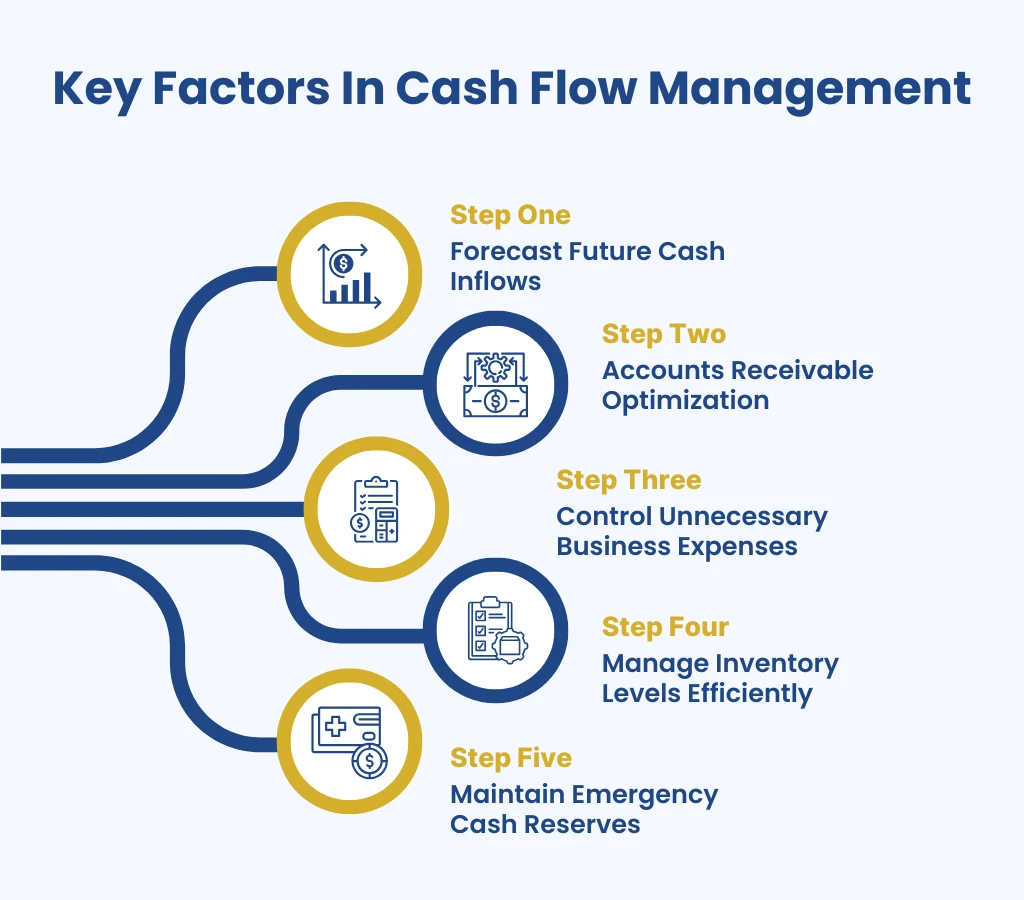
1. Cash Flow Forecasting
Forecasting predicts your future cash position by estimating future income and expenses.
Best Practices:
- Set weekly and monthly forecasts.
- Update regularly in real time.
- Prepare best- and worst-case operational plans.
2. Accounts Receivable Optimization
Cash flow issues arise from late payments.
Suggestions:
- Send invoices as soon as possible.
- Provide discounts for early payments.
- Set up automated reminders
- Have a strict policy around extending credit.
3. Expense Control
Monitoring your expenses allows you to control overspending.
Strategies:
- Review your expenses by category and by month.
- Cancel subscriptions that are not being used.
- Renegotiate with your vendors.
- Use cheaper and more effective tools.
4. Inventory Management
Cash flow and sales are impacted by both retention and having too little inventory.
Solution:
- Use demand forecasting
- Maintain optimal stock levels
- Track slow-moving inventory
5. Emergency Cash Reserve
Every business should maintain a buffer for unexpected situations.
Recommended:
- Keep at least 3–6 months of operating expenses
- Store funds in a liquid account
Common Cash Flow Problems (and How to Solve Them)
Problem 1: High Revenue but Low Cash
Cause: Delayed receivables
Solution: Improve billing cycles and collections
Problem 2: Seasonal Business Fluctuations
Cause: Inconsistent income streams
Solution: Build reserves during peak seasons
Problem 3: Overexpansion
Cause: Growing too fast without cash backing
Solution: Scale gradually and monitor cash flow closely
Problem 4: Poor Financial Tracking
Cause: Lack of proper accounting systems
Solution: Use cloud accounting software and professional services
Tools and Technology for Cash Flow Management
In 2026, technology will play a major role in managing cash flow efficiently.
Popular Tools:
- Cloud accounting software (real-time tracking)
- Cash flow forecasting tools
- Automated invoicing systems
- Expense tracking apps
These tools help reduce manual errors and provide real-time financial insights.
Cash Flow Management Strategies for Small Businesses
1. Shorten Payment Cycles
Encourage faster payments through digital invoices and online payment options.
2. Extend Payables (Smartly)
Negotiate better payment terms with vendors without damaging relationships.
3. Diversify Revenue Streams
Relying on a single income source increases risk. Explore multiple channels.
4. Monitor Cash Flow Weekly
Don’t wait for monthly reports track cash flow regularly for better control.
5. Outsource Accounting Services
Partnering with experts like KeyCMS Accounting ensures accurate tracking, forecasting, and strategic planning.
How KeyCMS Accounting Helps Your Business
At KeyCMS Accounting, we provide tailored Cash Flow Management Solutions for USA-based businesses:
- Real-time cash flow tracking
- Accurate forecasting and budgeting
- Accounts receivable and payable management
- Financial reporting and insights
- Virtual CFO services
Our goal is to help you maintain a steady cash flow so you can focus on growing your business.
Future Trends in Cash Flow Management (2026 and Beyond)
- AI-powered forecasting for better accuracy
- Real-time financial dashboards for instant insights
- Automation in invoicing and collections
- Integration with banking systems for seamless cash tracking
Businesses that adopt these trends will have a competitive advantage.
Conclusion
Your organization’s cash flow is your customer lifeline. Without cash flow management systems in place, even cash flow positive businesses can get into trouble. Building a stable financial framework for sustainable success requires smart planning, technology, and specialist intervention like KeyCMS Accounting.
It’s now or never for both startups and established businesses to pull cash flow systems in place and secure the future.
FAQs
1. What is the difference between cash flow and profit?
Profit shows the money left when you take out all the expenses bills out of revenue\money coming in. Cash flow is how money moves in and out of the business.
2. How often should I monitor cash flow?
The short answer is small businesses should monitor their cash flow every week to have a better understanding of their finances.
3. What causes cash flow problems in small businesses?
There are a number of reasons cash flow issues occur. Some include late payments, expenses, forecast errors, and lack of sound financial planning.
4. How can I improve my cash flow quickly?
You can improve cash flow by speeding up collections, lowering expenses, and getting better terms with your vendors.
5. Is cash flow forecasting necessary for small businesses?
Yes, because it aids in financial planning, decreasing the risk of a cash shortfall.
6. Should I outsource cash flow management?
Yes, better cash flow management can be achieved by outsourcing to professionals, such as KeyCMS Accounting, so you can spend your time more effectively.
7. What is a healthy cash flow for a small business?
The business has a healthy cash flow if it has the money to pay expenses, invests in the business, and can deal with emergencies.