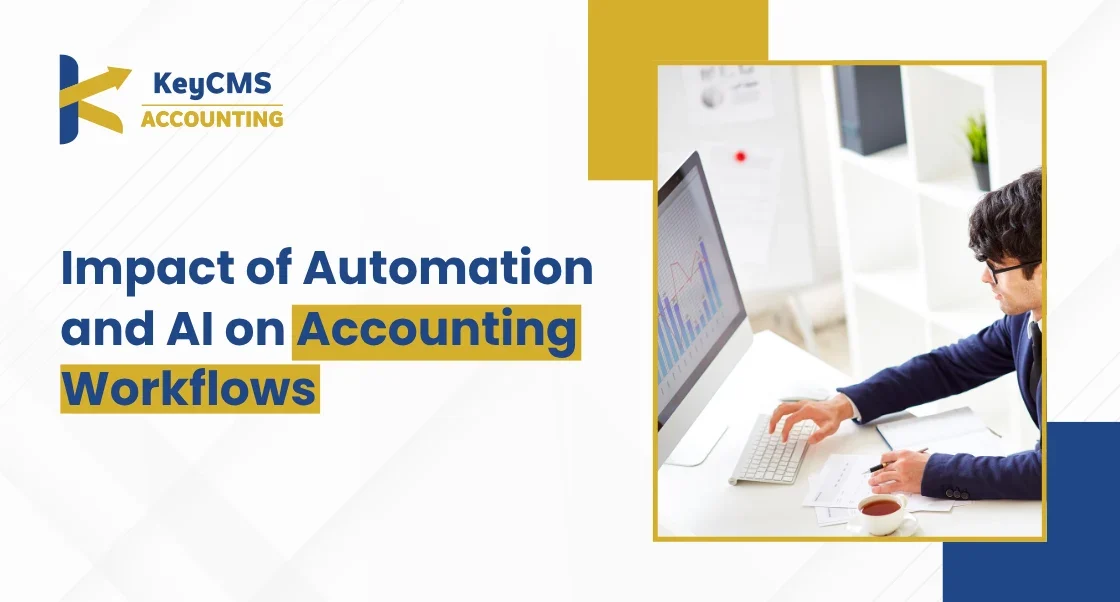
One of the many ways that technology has changed the workforce is the development of automation and AI. In the accounting sector, these technologies have allowed for rapid development and process improvement at all levels. This isn’t just a change in technology but a change in the way professionals in the space work. New roles and skill sets are demanded as technology is integrated into the Accounting Workflow.
No longer are the days of manual bookkeeping and an iterative auditing process. AI systems are developing at an incredible pace and constructing a new way of accounting as a whole. In the Accounting field, there are seven distinct ways that AI is changing accounting workflows.
7 Key Ways AI Is Transforming Accounting Workflows
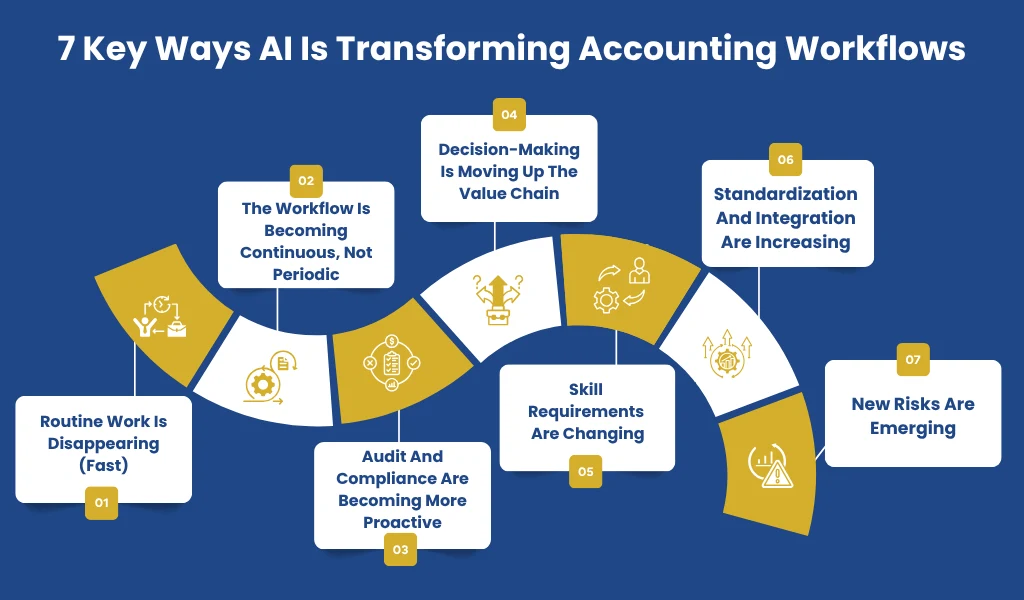
1. Routine work is disappearing (fast)
Tasks like data entry, invoice processing, Bank Reconciliations, and basic bookkeeping are increasingly handled by AI-powered systems and robotic process automation (RPA). Tools can:
- Extract data from invoices using OCR + AI
- Auto-categorize transactions
- Reconcile accounts in real time
What used to take hours now happens in seconds, often with fewer errors.
2. The workflow is becoming continuous, not periodic
Traditional Accounting worked in cycles monthly closes, quarterly reports. AI shifts this toward real-time accounting:
- Transactions are processed instantly
- Dashboards update continuously
- Financial positions are always current
This reduces the “end-of-month scramble” and changes how teams allocate time.
3. Audit and compliance are becoming more proactive
AI systems can scan entire datasets (not just samples) to:
- Detect anomalies or fraud patterns
- Flag compliance risks early
- Monitor transactions continuously
This is a big shift from reactive audits to continuous assurance.
4. Decision-making is moving up the value chain
Because AI handles the mechanical work, accountants are expected to:
- Interpret financial data
- Provide strategic insights
- Advise on cost optimization, forecasting, and risk
In other words, the role is moving from “record-keeping” to business advisory.
5. Skill requirements are changing
The technical baseline is shifting:
- Less emphasis on manual bookkeeping
- More emphasis on data analysis, systems thinking, and judgment
- Familiarity with tools (ERP systems, analytics platforms, AI tools) becomes essential
- Accountants who rely only on traditional skills risk being left behind.
6. Standardization and integration are increasing
AI works best with clean, structured data. As a result:
- Companies are standardizing processes
- Systems (ERP, payroll, tax, reporting) are becoming more integrated
- Data silos are being reduced
This improves visibility but also requires upfront investment.
7. New risks are emerging
It’s not all upside. Automation introduces:
- Model errors or biased AI outputs
- Over-reliance on systems without human review
- Cybersecurity and data privacy concerns
Human oversight is still critical just in a different form.
Conclusion
AI and automation are changing Accounting, not removing it, and most significantly, changing the types of jobs in the industry rather than eliminating them altogether.
Repetitive tasks at the lower levels are getting removed entirely, and in their place, higher-level tasks, such as analysis, strategy, and advisory roles, are expanding. This shifts the way all Accountants create value.
Accounting’s future is in the hands of people who can think analytically and commercially, who have the technical knowledge and the ability to pivot and adapt to new technologies. The accountants who use AI to their advantage will stay relevant and will actually become more important in steering the business towards success.
FAQs
1. How is AI changing traditional accounting workflows?
AI is transforming accounting by automating repetitive tasks like data entry, reconciliation, and transaction categorization, allowing accountants to focus on higher-value activities.
2. What accounting tasks can be automated using AI?
Tasks such as invoice processing, bank reconciliations, Bookkeeping, and data extraction using OCR are now commonly automated with AI and RPA tools.
3. What is real-time accounting, and why does it matter?
Real-time accounting means financial data is processed and updated continuously, giving businesses instant insights and eliminating delays associated with monthly or quarterly reporting.
4. How does AI improve auditing and compliance?
AI enables continuous monitoring of financial data, helping detect fraud, anomalies, and compliance risks early, rather than relying only on periodic Audits.
5. Will AI replace accountants?
No, AI is not replacing accountants but changing their roles shifting focus from manual tasks to strategic advisory, analysis, and decision-making.
6. What new skills do accountants need in an AI-driven environment?
Accountants need skills in data analysis, financial interpretation, technology tools (ERP, analytics platforms), and strategic thinking to stay competitive.
7. What are the risks of using AI in accounting?
Potential risks include inaccurate AI outputs, over-reliance on Automation, data privacy concerns, and cybersecurity threats making human oversight essential.