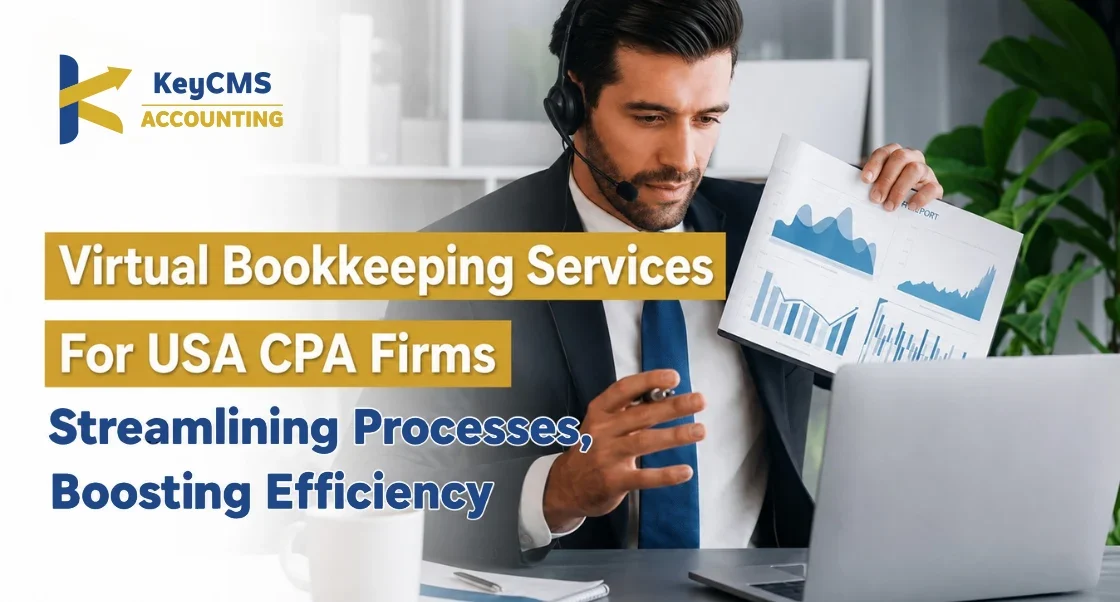
An operational shift is occurring for virtually all CPA Firms in the United States. Client demands, complexity of regulations, shortage of skilled professionals, and high costs of labor are making an impact on the traditional models of in-house accounting. Simultaneously, CPA firms are required to provide quicker reports, more thorough insights on the finances, and increased levels of support in the form of consulting.
Virtual bookkeeping services are changing the paradigm.
Instead of merely outsourcing tasks, more progressive CPA firms are establishing Remote Bookkeeping partnerships that optimize back-office processes, increase all-around efficiencies, and allow CPAs to concentrate on more complex and value added tasks. In this sense, Virtual Bookkeeping Services have become an important strategic instrument for growth, as opposed to a service created solely for cost containment purposes.
What Are Virtual Bookkeeping Services?
Virtual bookkeeping services are offered remotely and supported by proprietary accounting software and secure cloud collaboration tools.
Rather than recruiting and supervising an internal Bookkeeping team, CPA firms partner with remote bookkeeping professionals who assimilate into the firm’s workflow.
Services offered include but are not limited to:
- Recording and classifying transactions
- Reconciliation of bank and credit card accounts
- Management of accounts payable and receivable
- Assistance with payroll
- Preparation of financial statements
- Support for month-end and year-end closing processes
All work is conducted through platforms like Quick Books Online, Xero, Gusto, and secure document-sharing systems to ensure real-time visibility and control.
Why USA CPA Firms Are Turning to Virtual Bookkeeping
1. Increasing Demand for Skilled Accounting Professionals
More and more U.S. bookkeeping positions are going unfilled. Virtual teams hire for bookkeeping and other managerial professions without the need for local hiring obstacles.
2. Budgeting
Employees are expensive. Staff salaries and dynamic and fixed costs of personnel training, office space, and personnel management are significant. Bookkeeping Services turn these costs into variable service costs that can be optimized for scalability.
3. Unpredictable Workflow Demands
Tax season is stressful and creates peaks and valleys in staffing demands. Virtual support makes the workload more manageable for CPA firms.
4. High-Value CPA Services
Off routine bookkeeping, CPAs are allowed more time in practices such as:
- Tax planning
- Financial advisory
- Audits
- Client strategy and growth consulting
Key Processes That Virtual Bookkeeping Streamlines
Virtual bookkeeping teams add structure, consistency, and automation to daily accounting processes.
- Bank & Credit Card Reconciliations – Quicker matching and fewer discrepancies
- Accounts Payable & Receivable – Prompt bill reminders and invoice collections
- Payroll Support – Ensures payroll data is processed accurately
- Financial Reporting – Monthly statements organized for CPA review
- Month-End & Year-End Closing – Processed closing done uniformly
- Data Entry Automation – Manual error reduction by software integration
All the above add up to better financial visibility and cleaner financial records.
Efficiency Benefits for CPA Firms
Virtual bookkeeping enhances the performance of the entire firm by providing:
- Quicker turnaround times for client bookkeeping
- Standardized workflows leading to fewer mistakes
- Enhanced organization of documents
- More consistent reports
- Higher client satisfaction
- Increased productivity due to time zone differences
- Improved global reach
Thus providing more seamless operations and improved Service delivery predictability.
Technology Behind Virtual Bookkeeping
The success of virtual accounting hinges on the use of technology. CPA firms are able to take advantage of:
- Cloud accounting software (QuickBooks Online, Xero)
- Task tracking workflow management systems
- Secure systems for file sharing
- Automation systems to minimize manual data
- Data protection systems with access controls and encryption
The technological environment guarantees USA Accounting standards to be met with accuracy and transparency.
How Virtual Bookkeeping Supports CPA Firm Growth
Virtual bookkeeping allows companies to grow without stretching their operations.
- Increase client numbers without adding to your office headcount.
- Increase profit by lowering your fixed costs.
- Increase your range of advisory and tax work.
- Broaden your service offerings.
- Keep your service quality when you grow.
It provides a flexible operational framework for sustained growth.
How KeyCMS Accounting Supports Virtual Bookkeeping
KeyCMS Accounting collaborates with US CPA Firms to deliver dependable Virtual Bookkeeping support driven by processes.
We concentrate on:
- Recording transactions accurately on a daily basis
- Reconciliations and reporting on time
- Support for month-end closing
- Workflows that are standardized to the CPA firm’s requirements
- Financial data handled with the utmost security
- Integration with your tools and processes without disruption
Our goal is to alleviate your operational burden so that you may concentrate on advisory, compliance, and client expansion.
Future of CPA Firms + Virtual Accounting
The accounting industry is adapting to a hybrid model that integrates in-house CPAs with virtual support teams.
Future trends shaping the industry include:
- More automation in bookkeeping
- Increased use of cloud technology
- Standardization of remote collaboration
- The move of CPAs to advisory-focused revenue streams
To help firms remain competitive, virtual bookkeeping is essential.
Conclusion
Virtual Bookkeeping Services have moved beyond being a simple outsourcing option to becoming a strategic differentiator for CPA firms. By fine-tuning processes and fostering efficiency and scalable growth, virtual bookkeeping empowers firms to manage and optimize costs while improving service delivery.
For CPA firms seeking to manage operational pressure while enhancing profitability, virtual bookkeeping offers a cost-effective and sustainable option.
FAQs
1. Is virtual bookkeeping secure for CPA firms?
Yes. Reputable providers use encrypted systems, secure access controls, NDAs, and strict data protection policies.
2. Will I lose control over my client data?
No. CPA firms maintain full visibility and approval authority through cloud-based systems.
3. Can virtual bookkeeping handle U.S. accounting standards?
Yes, trained professionals work according to GAAP and CPA firm guidelines.
4. Is this suitable for small CPA firms?
Absolutely. Small and mid-sized firms benefit the most from scalability and cost control.
5. How quickly can services be implemented?
Most Virtual Bookkeeping setups can begin within a short onboarding period, depending on workflow complexity.