Today’s digital economy is changing the way companies conduct and strategize their financial management. Traditional in-house accounting models are expensive and rigid and require physical presence in order to properly function. With the rise of remote work and cloud-based systems, remote accounting services are becoming a better solution for more efficient work.
With remote accounting, professionals are no longer bound by their geographical location; therefore, businesses of all sizes are taking advantage of remote accountants. They save money and improve their accounting accuracy and insights, as well as gain timely financial updates. This blog aims to provide an overview of remote accounting services, what drives their rapid growth, and the various advantages they offer businesses.
What Are Remote Accounting Services?
Remote accounting services involve the use of professional accounting and bookkeeping services, carried out virtually via cloud computing and secure digital services. Remote experts handle all of the accounting functions for a company, as opposed to hiring an in-house accountant.
Services offered include daily bookkeeping, payroll, financial reporting, tax compliance, and advisory services. All the functions of accounting are covered, even without the dependence of a physical office. Collaboration is done through email, accounting software, and video calls.
Why Businesses Are Moving to Remote Accounting
Businesses spanning multiple industries are adopting remote accounting for several practical and strategic reasons:
- Cost increases associated with hiring and retaining in-house employees
- Widespread use of cloud accounting solutions
- Real-time insights are needed regarding the company’s financial situation.
- Scalability requirements during growth or seasonal fluctuations
Remote accounting meets the most contemporary business requirements in terms of speed, flexibility, and data-driven decisions, which explains its rapid adoption among progressive businesses.
Benefits of Remote Accounting Services
1. Cost Reduction
Remote accounting helps businesses to eliminate costs associated with salaries, employee benefits, office space, and training. Companies pay only for the accounting services required.
2. Access to Specialized Expertise
Remote accounting allows businesses to work with specialized accountants, CPAs, and other experts from different areas without location barriers.
3. Up-to-Date Financial Information
Remote accounting allows businesses to access cloud-based accounting systems and get reports with the most current data. This allows them to make decisions faster and with better information.
4. Flexibility and Scalability
During periods of business growth or high season demand, remote services can be scaled without the need to make long-term commitments, including hiring.
5. Increased Compliance and Accuracy
Better compliance and a decreased risk of accounting errors are a result of remote services using standardized processes and staying up-to-date on accounting law and regulation changes.
6. Increased Focus on the Business
Focusing on business growth, strategy, and customer relationship management is made easier when accounting services are outsourced.
Services Commonly Offered
Remote accounting services are comprehensive and customizable. Common offerings include:
- Bookkeeping (daily, weekly, or monthly)
- Accounts payable and receivable management
- Bank and credit card reconciliations
- Payroll processing and support
- Financial statements and management reports
- Budgeting and forecasting
- Sales tax and compliance support
- Year-end closing and audit preparation
- CFO-level advisory services
Businesses can choose full-service accounting or specific functions based on their needs.
Technology Behind Remote Accounting
The foundation of remote accounting services is technology. Modern remote accounting professionals utilize safe cloud technology to provide services that are both precise and efficient.
Typical technologies include:
- Cloud accounting software (Xero, QuickBooks Online, NetSuite)
- Tools for tracking expenses and receipts
- HR and payroll services
- Systems for the secure sharing of documents
- Tools for automated reconciliation and artificial intelligence
All of these technologies provide remote accounting partners with secure data, real-time access, and seamless collaboration.
Who Can Benefit the Most?
Remote accounting services are ideal for:
- Startups and small businesses needing budget-friendly financing assistance
- Evolving organizations needing flexible accounting options
- E-commerce and SaaS companies needing complex transaction management
- Professional services needing precise service reporting
- CPA firms needing to subcontract their accounting and bookkeeping services
- Global organizations with complex multi-site operational structures
Any company with a desire for efficiency, transparency, and remote accounting services.
How to Choose the Right Remote Accounting Partner
Choosing the best partners is essential. Keep the following in mind:
- Industry Experience: Pick a provider who understands your business model.
- Tech expertise: Ensure they cover your accounting software preferences.
- Security and Confidentiality: Strong protection and clear policies.
- Scalability: The partner must grow with your business.
- Support: Responsive communication and clear reporting.
- Regulatory Knowledge: They should be up to date with accounting and tax regulations.
A trustworthy remote accounting partner will act as an extension of your team, not a vendor.
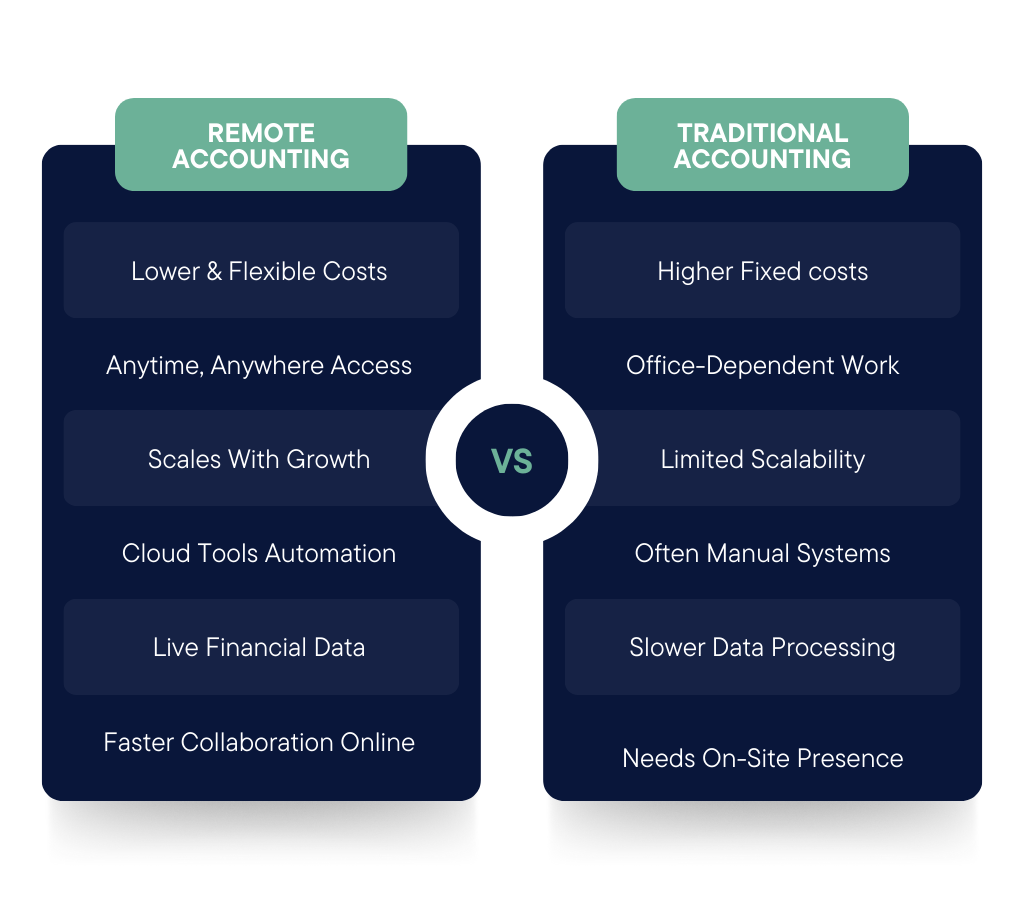
Remote Accounting vs Traditional Accounting
Future of Remote Accounting
Accounting first developed as a purely remote practice. Looking ahead, considering current developments in AI, automation, and cloud computing, remote accounting, and in particular predictive and strategy remote accounting, will continue to evolve. Businesses will continue to rely on, and even need, real-time analytics, virtual CFO solutions, and automated, data-driven financial strategies.
The evolution of remote work as an industry standard will further drive remote accounting as a primary financial management model for businesses.
Conclusion
The clear positive impact of remote accounting services on businesses financial management processes will be discussed in the following chapters and will be clear from the evidence presented. Remote accounting, because of its expert knowledge, technology, and service flexibility, will provide more accurate, more efficient, and more strategically valuable services.
For modern businesses trying to cut expenses, gain financial clarity, and scale without losing control, remote accounting will be more than a wise solution and will become a competitive advantage.
FAQs
1. What are remote accounting services?
Remote accounting services are professional accounting and bookkeeping services delivered virtually using cloud-based software, allowing businesses to manage finances without hiring in-house accountants.
2. How do remote accounting services work?
Remote accountants access your financial data securely through cloud accounting platforms, manage transactions, prepare reports, and communicate with you online in real time.
3. Are remote accounting services safe and secure?
Yes. Reputable providers use encrypted systems, secure cloud platforms, and strict confidentiality protocols to protect financial data.
4. What types of businesses use remote accounting services?
Startups, small and mid-sized businesses, e-commerce companies, CPA firms, and growing enterprises commonly use remote accounting services.
5. What services are included in remote accounting?
Services typically include bookkeeping, payroll support, accounts payable and receivable, reconciliations, financial reporting, tax support, and advisory services.
6. Is remote accounting more affordable than in-house accounting?
In most cases, yes. Remote accounting eliminates costs related to salaries, office space, benefits, and training while offering flexible pricing.
7. Can remote accountants help with tax compliance?
Yes. Many remote accounting providers assist with tax preparation, compliance, filings, and year-end reporting.
8. What accounting software is used for remote accounting?
Common software includes QuickBooks Online, Xero, NetSuite, and other cloud-based accounting platforms, depending on business needs.
9. How do I communicate with my remote accounting team?
Communication typically happens through email, video calls, shared dashboards, and accounting software messaging tools.
10. How do I choose the right remote accounting service provider?
Look for industry experience, strong data security, cloud technology expertise, clear communication, scalability, and compliance knowledge.