The accounting industry is changing quickly, with CPA Firms facing seemingly unrelenting workloads, tight deadlines, and increasing costs to run their business. This is the case even if firms work to improve their operational efficiency and quality in the delivery of a diverse range of financial services, including tax preparation, Bookkeeping, financial reporting, and compliance services.
In order to manage more of the heavy lifting work, CPA firms are beginning to construct accounting teams in other geographical locations. Most of these firms see offshore team construction as a means to access Accounting talent at a lower cost than hiring professionals in their own economies. With the right talent, teams constructed in other locations can help CPA firms manage their workloads while effectively and efficiently performing accounting tasks.
In this guide, we will discuss the best ways these firms can optimize the running of their Offshore Accounting Teams, the challenges they are likely to face, and the benefits these teams are likely to provide.
Why CPA Firms Are Turning to Offshore Accounting Teams
An increase in demand for Accounting Services can be observed particularly during tax season. While this is true, CPA Firms still need to deal with the following issues:
- Lack of sufficient qualified accounting personnel
- Increased employee remuneration alongside operational costs
- Increased workload during peak season
- Requirement for specific accounting knowledge
An efficient solution to these issues is Offshore Accounting Services. With offshoring, CPA firms can outsource some of their accounting services to specially trained overseas personnel, thus allowing them to concentrate on more profitable services such as advising clients and planning their finances.
On top of the abovementioned advantages, offshoring creates the potential for CPA firms to enhance their operational efficiency by utilizing the different time zones and their resultant workflow cycles.
What Is an Offshore Accounting Team?
An offshore accounting team consists of accounting professionals based in other countries who offer accounting services to your CPA firm.
These teams typically handle:
- Bookkeeping
- Preparation of tax returns
- Management of accounts payable and receivable
- Financial reporting
- Processing of payroll
- Reconciliation of bank accounts
Offshore teams extend your team’s capabilities, and integrate seamlessly with your team through accounting in the cloud and secure systems to facilitate communication and data flow.
Key Benefits of Building an Offshore Team
1. Operational Savings
The major benefit of outsourcing accounting work is lower operational costs. CPA firms do not have to pay employee salaries, provide office space, make training investments, or build out the necessary infrastructure.
2. Availability of Quality Talent
There are an abundant number of exceptionally qualified accountants who focus on international accounting and even use international accounting standard methods and resources at many offshore centers.
3. Flexibility
During busy seasons, CPA firms have the ability to quickly and easily expand their services by using offshore-based workers instead of having to hire permanent employees.
4. Enhanced Firm Focus
CPAs can concentrate on higher value advisory work and building relationships with clients by outsourcing basic accounting functions to offshore employees.
5. Better Client Service
Because of the time difference, clients will experience shorter wait times for their accounting projects as work will continue even after the local office has closed.
Step-by-Step Guide to Building an Offshore Accounting Team
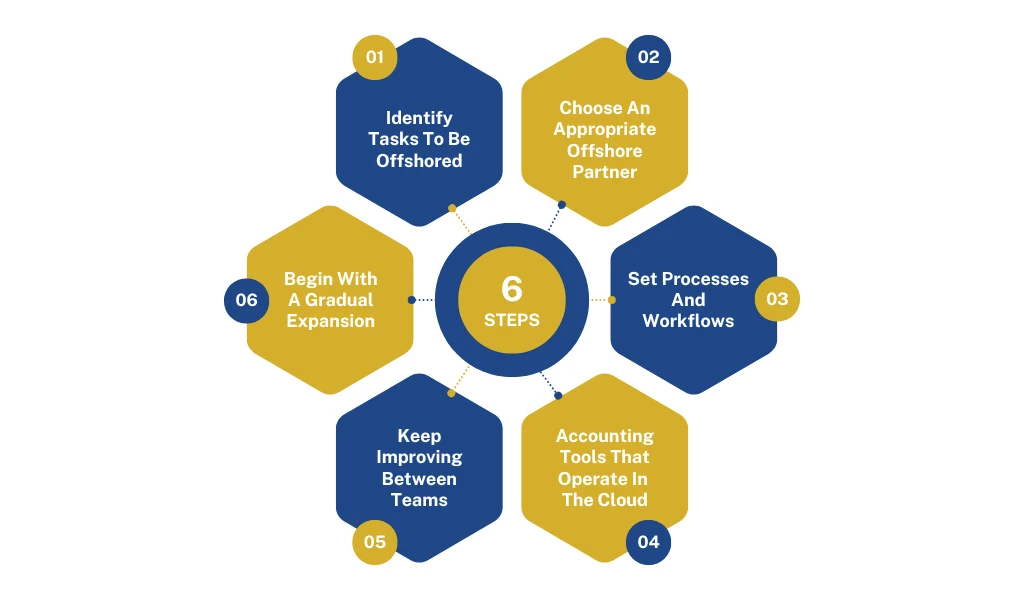
Step 1: Identify Tasks to be Offshored
Account for which tasks in your accounting can be left to outside employees. Offshoring is best for tasks that are systematic. Simple tasks include data entry and process calculations.
Step 2: Choose an Appropriate Offshore Partner
It’s best to find an offshore accounting company. Evaluate their number of employees and their knowledge of data-sensitive industries.
Step 3: Set Processes and Workflows
Documentation ensures that team members understand the job. Tasks assigned should be accompanied by an organizational guide that defines tasks, time, and places for the reports.
Step 4: Accounting Tools that Operate in the Cloud
Offshore team partners such as service providers for QuickBooks and Xero should be integrated with each other.
Step 5: Keep Improving Between Teams
Offshore team partners such as service providers for QuickBooks and Xero should be integrated with each other.
Step 6: Begin with a Gradual Expansion
It is best to start a small offshore team and then expand as your knowledge of the process grows.
Common Mistakes CPA Firms Make When Offshoring
Despite the numerous benefits of Offshoring, some companies still encounter difficulties that can be attributed to simple errors.
Some of the more frequent errors include:
- Communication and expectation issues
- Vendor selection based solely on cost
- Data security practices ignored
- Workflows that have not been clearly defined
- Insufficient training of offshoring personnel
Addressing these issues will lead to a more successful offshore accounting strategy.
Data Security & Compliance Considerations
Protecting sensitive financial information is a priority for CPA firms.
When building an offshore accounting team, firms should ensure:
- Cloud accounting is secure
- Signed Non-Disclosure Agreements
- Data protection compliance
- Access Control
- Security Audits
Choosing a trustworthy offshore partner minimizes risk and confidentiality, and ensures compliance with industry best practices.
Offshore vs In-House: Cost & Efficiency Comparison
| Factor | Offshore Team | In-House Team |
| Cost | Lower operational costs | Higher salaries and overhead |
| Scalability | Easy to scale quickly | Hiring takes time |
| Talent Pool | Global access to skilled accountants | Limited to local market |
| Infrastructure | Managed by offshore provider | Requires office space and resources |
| Productivity | Extended work hours via time zones | Limited to office hours |
For many CPA firms, Offshore Teams provide a more flexible and cost-effective solution.
Is Offshore Accounting Right for Your CPA Firm?
Offshore accounting can be a great solution if your firm:
- Experiences heavy workloads during tax season
- Wants to reduce operational costs
- Needs access to skilled accounting professionals
- Wants to scale services quickly
However, success depends on choosing the right offshore partner and establishing strong processes.
Why Partner With KeyCMS Accounting
KeyCMS Accounting specializes in providing offshore accounting solutions tailored specifically for CPA firms.
Our services include:
- Bookkeeping and financial reporting
- Tax preparation support
- Payroll processing
- Accounts payable and receivable management
- Dedicated offshore accounting staff
With experienced professionals, secure workflows, and scalable solutions, KeyCMS Accounting helps CPA firms streamline operations and focus on growth.
Conclusion
Building an offshore accounting team is no longer just a cost-saving strategy it’s a powerful way for CPA firms to improve efficiency, access global talent, and scale operations.
By following the right approach, establishing clear workflows, and partnering with a trusted offshore accounting provider, CPA firms can transform their operations and deliver greater value to clients.
As the accounting industry continues to evolve, offshore accounting teams are becoming an essential component of modern CPA firm growth strategies.
FAQs
1. What is an offshore accounting team for CPA firms?
Offshore accounting teams are groups of Remote Accounting professionals who support CPA firms by doing tasks like bookkeeping, tax preparation, payroll processing, preparing financial statements, and reconciling accounts from secure locations in other countries. Offshore accounting teams are considered part of the firm’s team and work with the firm’s domestic accountants remotely using secure cloud-based Accounting Software.
2. Why do CPA firms build offshore accounting teams?
Offshore accounting teams help CPA firms reduce their operational expenses, provide more value to their clients during tax season, access skilled accounting labor, improve overall workflow, and streamline tax processes to provide more advisory and client relationship management services.
3. Which accounting tasks can CPA firms offshore?
Tasks that CPA firms commonly offshore include bookkeeping, tax preparation, accounts payable and receivable, payroll, bank and Financial Statement Reconciliation, reporting, and data entry. Offshore teams take care of these basic tasks while in-house teams focus more on client advisory and strategy.
4. How much can CPA firms save by offshoring accounting work?
By developing an offshore accounting team, most CPA firms can save between 40% and 60% in operational costs. Most of these savings arise from the reduction in salary, office space and infrastructure, recruitment, and employee benefits.
5. Can CPA firms use offshore accounting services securely?
Offshore accounting can be secure when firms consider adopting protective measures such as data encryption, use of cloud services, non-disclosure agreements (NDAs), data regulatory compliance, and other mechanisms of protection.
6. How can CPA firms effectively supervise offshore accounting teams?
Effective supervision can be achieved through cloud accounting, accounting-specific project management systems, flowchart-driven project assignments, and periodic meetings. Smooth project execution and proper onboarding can promote sustained productivity and collaboration.
7. How do I find the best offshore accounting solution?
To find the best fit, CPA firms should consider the provider’s relevant functional area, security features, communication, adaptability, and assurance of seamless integration with the firm’s existing Accounting systems.