By 2026, startups will operate in a highly dynamic environment where speed, budgeting, and quick decision-making will be crucial. While conventional Accounting systems were once at the heart of financial management, there is now an effective alternative that will revolutionize the sector: virtual accounting.
To succeed in today’s highly competitive business environment, startups need to embrace efficiency, effectiveness, and scalability. Virtual Accounting is not only possible but necessary. This blog will discuss virtual accounting, its popularity, and why startups should prioritize it in 2026.
What Is Virtual Accounting?
It is a recent innovation that involves leveraging the power of the Internet for financial management purposes. Rather than having a dedicated accounting department, small businesses now have the option of outsourcing their financial transactions, which include Bookkeeping, payroll, tax preparation, and financial reporting, to virtual accountants.
Through this process, firms can gain the benefit of financial expertise irrespective of geographical barriers or physical office space constraints.
Why Startups Are Shifting to Virtual Accounting in 2026
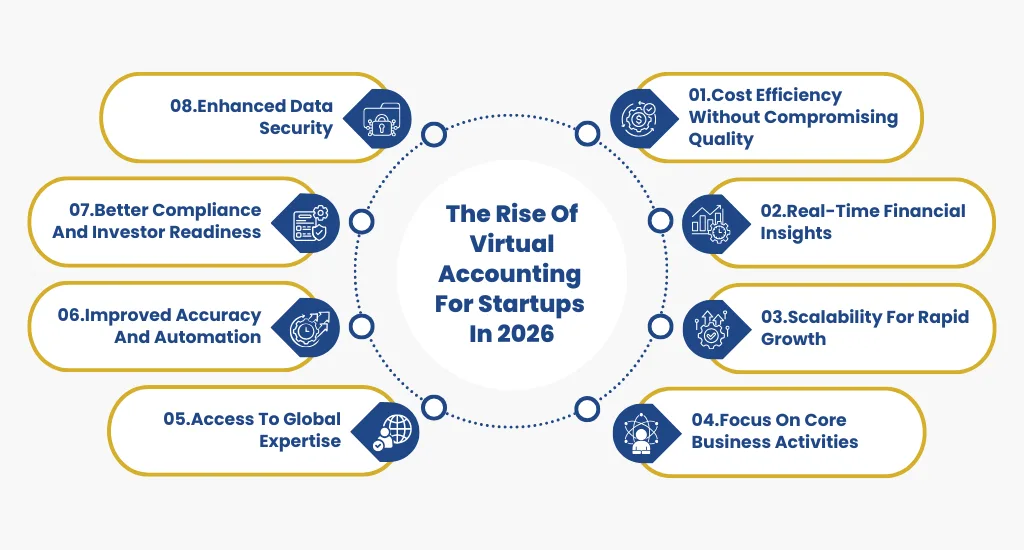
The startup environment of 2026 looks vastly different compared to a decade back. Entrepreneurs are faced with demands for rapid growth, financing, and financial prudence all without increasing expenses.
This is how virtual accounting makes more sense:
1. Cost Efficiency Without Compromising Quality
Full-time accountants or CFOs cost much money, particularly for startups at an early stage. The salary, perks, office space, and infrastructure cost a lot.
With virtual accounting, such expenses disappear. Startups can enjoy top-class financial knowledge at a significantly lower cost, sometimes reducing costs by 60%.
Even the highest positions such as CFOs can be virtually replaced. This means startups will only pay for what they require.
2. Real-Time Financial Insights
The most significant benefit of virtual accounting is real-time information on finance. There is no need to wait until the month-end; instead, founders are provided with instant cash flow, expenses, and revenue updates.
Having instant financial information helps entrepreneurs:
- Act faster.
- Keep an eye on the burn rate.
- Detect financial problems at an earlier stage
The cloud guarantees continuous access to all information.
3. Scalability for Rapid Growth
Startups expand their operations in an unpredictable manner. Your work begins with basic transactions but develops into advanced financial tasks that operate in different geographical areas.
Your business can use Virtual Accounting Services, which provide scalable solutions. The services provide instant scalability because they enable you to obtain payroll and tax compliance and financial forecasting services without needing additional staff.
The system provides ideal conditions for startups, which require solutions to handle their expanding operations and their evolving financial requirements.
4. Focus on Core Business Activities
Founders often spend too much time managing finances instead of focusing on growth, product development, and customer acquisition.
A Remote accounting system automates two tasks that include:
- Data entry
- Invoice processing
- Bank reconciliation
Startup teams can dedicate their time to strategic work because financial management tasks are handled by specialists.
The organization achieves higher productivity levels while its operational processes grow more efficient.
5. Access to Global Expertise
Remote accounting eliminates geographical constraints. Startups are able to collaborate with seasoned accountants, tax professionals, and financial experts irrespective of their geographical location.
This is particularly advantageous for startups that intend to
- Expand internationally
- Deal with transactions involving multiple currencies
- Comply with tax laws
Remote accounting ensures access to expert advice that might not be easily accessible locally.
6. Improved Accuracy and Automation
There is a high likelihood for mistakes in manual Accounting procedures, particularly when companies use spreadsheets and non-systematic approaches for recording financial transactions.
In virtual accounting:
- Errors made by people can be minimized.
- Data can be more accurate.
- Processes can be faster.
According to research, there are many more compliance errors when using manual accounting methods than Remote accounting methods.
7. Better Compliance and Investor Readiness
Investors will demand that startups keep clean and compliant financial books right from the start in 2026.
Some benefits of Remote accounting for startups include:
- Keeping accurate books
- Compliance with tax laws
- Preparing financial statements for investors
A good financial system builds credibility and increases funding opportunities.
8. Enhanced Data Security
Founders fear that their data will be compromised when they shift to virtual methods. Yet, today’s Virtual Accounting Software uses encryption technology, secure cloud servers, and frequent back-ups.
On the contrary, paper documents are at higher risk since they may get damaged, stolen, or accessed by unauthorized personnel.
Virtual Accounting vs Traditional Accounting
Let’s quickly compare the two approaches:
| Feature | Virtual Accounting | Traditional Accounting |
| Cost | Low, flexible | High, fixed |
| Accessibility | 24/7, remote | Limited to office hours |
| Scalability | Highly scalable | Limited |
| Speed | Real-time | Delayed reporting |
| Automation | High | Low |
| Flexibility | Global access | Location-bound |
The conclusion is clear: Remote accounting is built for the modern startup ecosystem, while traditional accounting struggles to keep up.
Common Challenges Startups Face Without Virtual Accounting
Businesses that utilize obsolete Accounting practices face challenges such as the following:
- Inconsistent or insufficient accounting records
- Insufficient cash flow visibility
- Tax difficulties
- Unsound financial decisions
It is evident that ineffective financial management may be one of the leading factors behind startup failure.
The Role of Virtual CFO in 2026
It is not confined to just Bookkeeping but stretches further into strategic financial management via virtual CFO (VCFO).
The functions of a VCFO include:
- Planning and forecasting
- Budget management
- Funding strategies
- Investor reporting
In this way, early-stage companies have an opportunity to benefit from the services of a professional CFO without having to hire one permanently.
Is Virtual Accounting Right for Your Startup?
Suitable candidates for virtual accounting are:
- Startups in early stages with tight budgets
- Startups that need to grow and scale up
- Teams working remotely or internationally
- Startups looking for real-time financial data.
But startups relying on cash or preferring face-to-face contact may choose to use more traditional means.
Conclusion
The approach towards financial management in 2026 has significantly evolved among startups. No longer merely a cost-effective measure, Remote accounting is seen as an advanced strategy for developing a more efficient financial management approach.
Offering real-time visibility and Automation, as well as international experience, Remote accounting enables startups to run their operations efficiently.
If you are starting your own business in 2026, embracing Remote accounting is not only important but also gives you a competitive edge.
FAQs
1. What is virtual accounting for startups?
It is a cloud solution that takes care of the startup’s financial processes like bookkeeping, Payroll, and filing taxes remotely through online platforms and professionals without requiring an on-site accountant.
2. How much does virtual accounting cost for startups?
It’s costs depend on various factors, but the general cost range starts from being 40-60% cheaper than employing a private accountant.
3. Is virtual accounting safe?
Definitely. Since all operations in virtual accounting are carried out in cloud storage and require passwords to log in, data protection and security measures can be considered extremely high.
4. Does virtual accounting solve tax problems?
Sure, virtual accountants know all the changes in the legislation concerning taxation and will help startups to avoid any penalties and issues with the authorities.
5. What are the methods used in virtual accounting?
The methods commonly used in Remote accounting include cloud-based software like QuickBooks, Xero, and Zoho Books along with other automation software.
6. Is virtual accounting appropriate for startup businesses?
Yes, It is appropriate for startup businesses, as it offers professional financial management services at an affordable price point and ensures accurate financial record keeping, allowing entrepreneurs to concentrate on expanding their ventures.
7. How does a virtual accountant differ from a virtual CFO?
A virtual accountant focuses on daily financial operations, such as Bookkeeping and compliance, whereas a virtual CFO focuses on strategic financial management, including budgeting, forecasting, and raising capital.