Finances are always fundamental to the successful running of any business. However, as operational costs increase, many USA companies will have to make cutbacks in areas such as accounting. Without careful, strategic management, accounting expenditures can affect several areas of a company’s overall budget. Companies identify activities such as payroll processing, tax prep, reporting, and compliance as areas where cost-effective, smart solutions are needed to maintain the existing levels of accuracy and compliance.
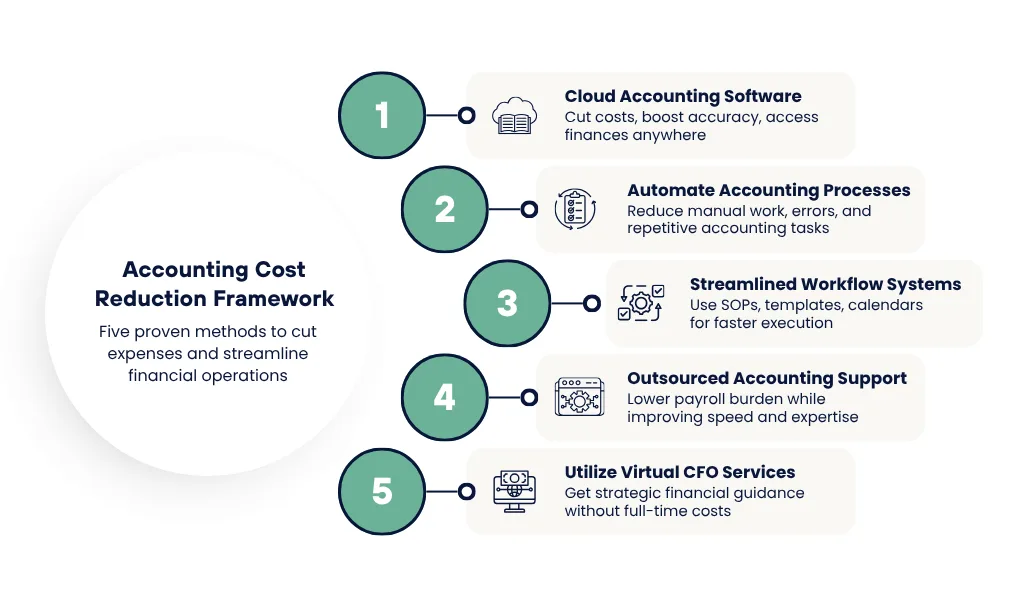
Digital transformation is enabling companies to use innovation, tactical outsourcing, and refined processes to lower costs in Accounting. This blog focuses primarily on effective outsourcing solutions while outlining the top five business strategies used to decrease accounting costs in 2026.
Top 5 Best Strategies to Reduce Your Accounting Costs
1. The Use of Cloud-Based Accounting Tools
One of the major shifts in accounting over the past 10 years has been the move from desktop-based systems to fully integrated cloud-based systems. This trend is fully expected to continue into 2026 and beyond and is becoming the industry standard for companies that want to be efficient and save money.
How it saves money:
- Lower initial investment : Cloud-based systems are usually subscription-based and do not require large initial investments for servers, licenses, and other infrastructure.
- Automatic updates : The software is always up-to-date and fully compliant with tax regulations so companies do not incur extra costs for software updates.
- Access from anywhere at any time : This is especially important for remote teams as it cuts down on the need for duplicate systems and manual reconciliations.
- Fewer errors : Many cloud systems automate the reconciliation process, which reduces costly human mistakes.
Leading tools in this field include QuickBooks Online, Xero, FreshBooks, and NetSuite.
When companies fully integrate cloud-based accounting tools, they lower their administrative costs and eliminate mistakes while improving collaboration and communication.
2. Streamlining Everyday Accounting Tasks with Automation
There are several repetitive tasks involved in accounting that are time consuming and expensive to complete manually. Tasks like data entry, processing invoices, and reconciling are all examples of monotonous work that are necessary to move forward with accounting.
From an accounting perspective, 2026 appears to be the year to look forward to with the rapid growth of artificial intelligence-powered tools that complete monotonous accounting tasks.
- Automated data capture: Receipt Bank and similar systems capture data from invoices and receipts.
- AI classification: transactions get assigned an appropriate category, and this decreases Bookkeeping time.
- Smart reconciliation: AIs do sophisticated matching of transactions to bank feeds.
From an accounting perspective, 2026 appears to be the year to look forward to with the rapid growth of artificial intelligence-powered tools that complete monotonous accounting tasks.
Cost benefits include the following:
- Reduced labor hours
- Faster month-end close cycles
- Better forecasting with predictive analytics
- Increased accuracy – minimizing penalties or compliance issues
With automation, companies not only save on Payroll costs but also free up their accounting teams to focus on high-value strategic work.
3. Fine-Tuning Internal Workflows and Creating Standards
Inefficient workflows and even the best software tools will not eliminate a bottomless pit of time and financial losses. In 2026, the most astute businesses will refine workflows to clear redundancies and enhance clarity.
Here’s how:
- Standard Operating Procedures (SOPs): In relation to the aforementioned goals, documenting each and every step of each and every accounting task creates uniformity and reduces the time spent training.
- Cross-Training: Versatile team members, who know multiple functions, can substitute when needed, minimizing the reliance on expensive temporary staff.
- Monthly Close Calendars: Timetables create structure and keep alignment. No more last-minute sprints to avoid expensive overtime.
Example: A company that previously allowed multiple teams to submit their disparate formats for expense reports now streamlines the process using a single template with an automated submission tool.
Small changes like this accumulate systemic workflows and efficient accounting cycles.
4. Outsource Certain Functions of the Accounting Department
Cost-saving strategies have always involved outsourcing, and from 2026 on, the landscape is shifting in terms of how such strategies are applied to accounting. Smart businesses are not outsourcing everything. Rather, they focus on outsourcing functions from accounting that provide the greatest strategic advantage.
These are the most common functions that provide such an advantage:
- Bookkeeping
- Payroll
- Preparation of taxes and related compliance
- Financial accounting and reporting
- Accounts payable and receivable
Outsourcing partners whether they are freelancers, specialist firms, offshore teams, or others provide business owners the opportunity to access quality accounting expertise and functions without the need to house an entire accounting team.
We will discuss this strategy in the next part, as it is one of the most effective ways of cutting down accounting costs without compromising on quality.
5. Use Virtual CFO Services for Planning
CFOs are quite expensive, so many companies are now employing part-time virtual CFOs (vCFOs) for specific projects. They provide valuable financial insights without the big salary commitments.
A virtual CFO can help with:
- Budgeting and forecasting
- Financially optimizing cash flows
- Financial analysis and KPIs
- Planning for strategic growth
- Risk assessments
Benefits of a Virtual CFO:
- Access to senior expertise for a fraction of the price
- Making financial decisions with more confidence
- Greater confidence from investors
- Business goal-oriented strategic planning
Rather than spending $10,000 to $30,000 a year for a full-time CFO, companies can use a Virtual CFO and significantly reduce their costs while maintaining value.
Cut Costs Without Cutting Corners: Hire Outsourced Accounting Experts
Outsourcing accounting functions can lead to significant cost savings for USA businesses in 2026.
Who should outsource?
- Businesses that can benefit most from outsourcing include:
- Small and midsize businesses with limited in-house personnel
- Startups with growing financial needs
- Established businesses that want to enable their internal employees to work on more strategic activities
- Businesses with fluctuating workloads
Types of Outsourced Accounting Models
- Offshore outsourcing: Engaging with companies from lower-cost countries that still meet quality standards (e.g., India, Philippines)
- Nearshore outsourcing: Engaging with countries that are geographically close and have aligned time zones for better collaboration.
- Specialized accounting firms: Local or national accounting firms with specific areas of expertise such as tax compliance or part-time CFO services.
- Hybrid models: models where there is a blend of outsourced execution and in-house supervision.
Why Outsourcing Works
- Reduced overall labor costs: Businesses pay for productive work-only hours, with no expense or liability for benefits, insurance, or other overheads.
- Access to expertise: Businesses have flexible access to professionals that have expertise in tax, financial compliance, and payroll, rather than hiring those costly employees full-time.
- Flexibility: Businesses can adjust outsourced services in line with their growth more easily than they can by hiring additional internal team members.
- Less overhead: Avoid system maintenance, office space, and internal training for complicated accounting processes.
How to Outsource Successfully
To save while keeping best outcomes:
- Define the scope of work.
- Select partners based on positive references and verified processes.
- Regularly communicate.
- Cloud systems integrate with outsourced workflows.
- Define and regularly review performance standards.
In outsourcing everyday accounting functions, many companies have been able to save 30 to 60 percent. These savings can be redirected to growth initiatives or operational enhancements.
Conclusion
Cutting down accounting costs doesn’t equate to lower standards. Astute USA companies will integrate technology, optimized processes, and strategic outsourcing for balanced financial operational efficiency in 2026.
Cloud automation and AI, outsourcing partnerships, and Virtual CFOs are proven to have enabled companies to remain compliant, innovative, and above all, save money. No matter if you are a small startup, or a fully established company, implementing these Accounting cost strategies will be a defining factor in your success in this new budget-centered business landscape.
FAQs
1. By how much can USA businesses cut their accounting costs in 2026?
Most businesses save anywhere between 20% and 60% in accounting costs based on how much they automate, streamline processes, and remove repetitive accounting tasks through outsourcing.
2. Is outsourcing accounting safe for confidential financial data?
Yes, but only if you work with a reliable outsourcing partner who complies with their company data security policy, uses secure cloud access, and has signed an NDA with confidentiality clauses.
3. What accounting tasks should businesses outsource first?
In terms of time, cost, and control, the most impactful tasks to outsource first are:
- Bookkeeping
- Payroll processing
- Accounts payable & receivable
- Bank reconciliations
- Month-end closing
These tasks are the best to outsource first.
4. Will automation and artificial intelligence diminish the demand for accountants?
Automation and artificial intelligence streamline processes and reduce the amount of work, but do not eliminate the need for accountants. Tax compliance, financial strategy, reporting accuracy, and decision-making support are areas for which businesses need professionals in 2026.
5. What is the biggest reason accounting costs increase in small businesses?
The main reason is manual processes like using spreadsheets for bookkeeping, lagging reconciliations, and messing with receipts which create mistakes, additional work, and increased professional fees.
6. Are virtual CFO services available to small businesses in 2026?
Yes! Virtual CFO services became a trend among small businesses because, for a fraction of the cost of a full-time CFO, they provide the following:
- Budgeting and forecasting
- Cash flow planning
- Profitability analysis
- Growth strategy
7. What do businesses need to consider when selecting an outsourced accounting partner?
Look for:
- Familiarity with American accounting principles
- Experience with QuickBooks/Xero
- Effective communicator
- Fair pricing
- Safe data storage and transfer
- Well-defined reporting procedures
A good partner should feel like an extension of your team.