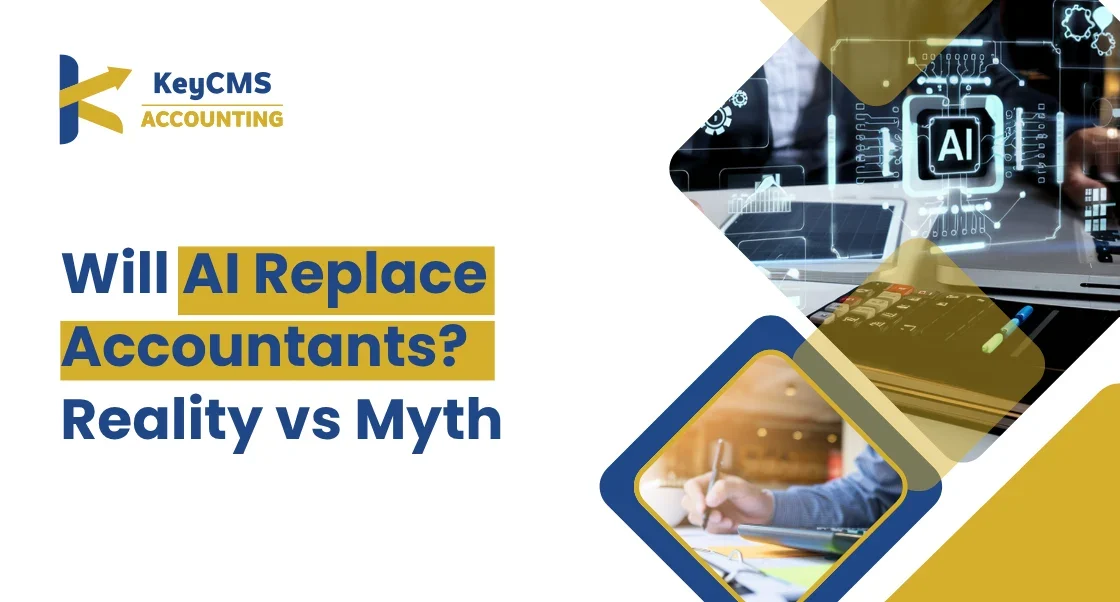
Every industry is being transformed by artificial intelligence (AI), and the accounting profession is no different. AI has automation tools and predictive analytics. It’s changing the processes for every CPA and Accounting Firm.
But the big question remains:
Will AI replace Accountants or simply redefine their role?
Considering the future of Accounting is complex and cannot be answered by simply saying, ‘yes’ or ‘no.’ We will look at the reality and determine the effects of AI on the profession of accounting.
Myth #1: AI Will Replace CPAs and Accounting Firms Entirely
This is largely misunderstood.
It’s believed that AI will develop to the point that it will make Accounting redundant. This perception is based on a gross misunderstanding about the accounting profession.
It’s true that AI is capable of massively speeding the data entry that Certified Public Accountants (CPAs) do. But AI lacks the ability to make the following four types of judgments that a CPA is capable of making:
- Professional judgment
- Ethical judgment
- Regulatory judgment
- Relational judgment
A CPA (Certified Public Accountant) does probably way more than Bookkeeping. They engage in strategic financial thinking, tax, compliance, and legal risks. All of that requires a judgment of a CPA’s education and experience in the context of diverse and complex financial environments.
No company will depend upon AI with no human oversight. AI can process data better than people, but techniques for financial and legal risk mitigation and strategic thinking in the long-term (decision making) will always require a human CPA’s education and experience.
The Reality: AI Is Transforming, Not Replacing
Tools like QuickBooks Online have incorporated AI into their service, signaling that AI is here to stay in accounting. AI is not here to take the job of accountants; rather, it will empower and optimize the jobs that accountants do.
Meeting today’s technological advancements, AI now has the ability to do the following:
- Automate things like bookkeeping and journal entries.
- Categorize transactions instantaneously.
- OCR (process images of paper writing) invoices.
- Reconcile bank and credit card transactions.
For Accounting Firms, AI optimizes us on the following:
- Manual work greatly reduced.
- Tasks completed in less time.
- Overall accuracy results in greater talking to the ratio of tasks completed.
Automation optimizes accountants on their tasks outside of the mundane, rather than value-taking tasks. Those hours of data collection become a time of evaluation and observation rather than accounting. AI enables accountability for advisers and tells stories of their evaluations rather than data collection.
Demand for Skilled CPAs Is Increasing
The need for higher-value services is increasing quickly as automation takes over basic tasks.
Accounting firms are expected to do so much more than compliance work. Companies see their accountant as their strategic partner in the business.
Today, an accountant is expected to:
- Give financial forecasts and insights.
- Define tax savings.
- Assist in financial decisions, and
- Aid in compliance.
Due to this trend, advisory and consulting Services are expected to grow. Unlike compliance work, advisory and consulting services are unlikely to become fully automated. Firms specializing in advisory work report growing client satisfaction and overall firm profitability.
AI is changing the accounting profession. More than the substitution of traditional compliance work, AI is changing client expectations.
The Risks and Limitations of AI in Accounting
AI is helpful, but it still has limitations and is not flawless.
AI still has limitations and can make mistakes, especially when handling complex or unusual financial scenarios.
AI can also lead to common errors such as the following:
- Getting transaction fields or categories wrong.
- Getting the financial context part wrong.
- Getting the rules part wrong.
AI works by using data and algorithms to operate and make decisions. When the input data is inaccurate or incomplete, it can easily produce incorrect results. It may also struggle to quickly adapt to frequent changes in tax laws and regulatory updates.
For these reasons, human validation is still needed in every accounting firm. AI can still get flexible changes and errors wrong, so accounting firms still need accountants for accurate work.
The Future Accountant = Advisor + Technology Expert
The role of the CPA has evolved to include more diverse responsibilities.
Accountancy has transformed beyond its traditional function to a more flexible skill, from number crunching to a requisite of accounting and financial management skills. Routine functions will be automated to give professionals the opportunity to extend their scope to include value-added functions.
The future of accounting has positioned professionals as the following:
- Tactical counselors
- Tech-centric professionals
- Narrative design professionals
Financial analysts are expected to carry out advanced functions of financial analysis and communicate their findings to facilitate the decision-making process of their stakeholders. A combination of technical skills and soft skills will define the new accounting profession.
How Accounting Firms Can Stay Ahead of AI
All CPAs and accounting firms must continue evolving to remain competitive in a world dominated by AI. Ignoring these changes and advances in technology is no longer a choice.
Here are several competitive strategies:
1. Accept AI and Technology
To increase efficiency and reduce error, accounting firms should adopt QuickBooks Online, AI reconciliation tools, and any workflow automation technology.
Firms that early adopt technology will continue to have a competitive advantage.
2. Advisory Services
Expand your services beyond compliance and begin providing higher-value services such as
- Financial Planning and Analysis
- Consulting Services
- Cash flow forecasting
Adding these services to ones offered is a way to increase firm revenue and create and foster relationships with clients.
3. Professional Development
Offer training to your team in relevant technology and services.
Three areas of focus include the following:
- Data Analytics
- Financial Modeling
- Improved Communication
Given the rate of change in the industry, it is no longer optional for firms to focus on the continuing education of their firm members. It is critical to embrace this focus to stay current with technologies.
4. Strengthen Client Relationships
Trust cannot be built upon AI.
Communication, understanding, personalized insight, and strong relationships are the cornerstones of any client relationship, and AI cannot achieve even one of these pillars despite having access to extensive amounts of data.
Regardless of the intricate and involved financial decisions that a business must make, personalized advisory will continue to be in demand.
Conclusion
No, CPAs and accountants won’t become obsolete because of AI.
Yes, AI will
- Take over mundane and predictable jobs
- CHANGE jobs from traditional roles
- Increase the need for higher-order skills concerning how the
Future accountants will have technical skills, embedded AI, and advisory skills. Those who resist the change will find it increasingly challenging to be relevant.
AI won’t end the Accounting profession. AI will mark the accounting profession’s continued evolution and the entry into an era of highly intelligent, more efficient, and more valuable practice.
FAQs
1. Will AI replace CPAs in the future?
Replacing CPAs with AI is impossible. AI can simplify basic data entry and basic accounting tasks that don’t require expertise. CPAs will continue to do advanced accounting like financial and tax analysis, compliance, and strategic counseling.
2. How is AI used in accounting firms today?
Here’s what AI can do in accounting firms today:
- It can substitute humdrum bookkeeping functions and classifications.
- It can do automatic bank transactions and credit card reconciliations.
- It can handle invoice processing and reconciliations through OCR technology.
It can deliver real-time financial reports through accounting automation like QuickBooks Online, etc.
3. Is AI a threat to accounting jobs?
AI will transform workplaces rather than threaten them. AI will mostly perform repetitive manual tasks. An accountant who leverages AI will become more desirable in the market and will deliver advisory services.
4. What skills do CPAs need in the age of AI?
To remain competitive, CPAs should improve their
- Proficiency in technology and software
- Skill in analyzing and interpreting data
- Ability to offer financial planning and advisory services
- Communication and client management skills
5. Will small accounting firms be affected by AI?
Yes, but mostly in a positive way. AI allows small accounting firms to:
- Increase efficiency
- Reduce operational costs
- Compete with larger firms through Automation and better insights
6. What are the benefits of AI in accounting for businesses?
AI offers several benefits for businesses, including:
- Faster financial data processing
- Improved accuracy with fewer human errors
- Real-time financial insights and reporting
- Cost savings through automation
By leveraging AI, businesses can make quicker and more informed financial decisions.
7. Can AI handle tax compliance and regulations completely?
No, AI cannot autonomously control tax compliance and regulations. AI can do the calculations and assist with data, but there is too much complexity and frequent changes in regard to tax laws. This is where your CPA comes in in regard to the compliance interpretation, risk management regulations, and the laws.