One of the most important functions of a business is Payroll. It is equally as important to ensure employees are paid punctually and precisely. Unfortunately, it is a business function that is most prone to fraudulent activity. Regardless of whether a business is a new small business or a large enterprise, the potential damage payroll fraud can cause, including loss of money, legal issues, and damage to the company’s reputation, is significant.
What is Payroll Fraud?
Employees and employers alike can exploit the payroll system to receive payments to which they are not entitled. This manipulation can occur through collusion with administrative staff, such as human resources and payroll directors, or through outside perpetrators who hack into the payroll system.
Organizations that fail to implement solid internal controls are particularly vulnerable to this type of fraud, as evidenced by industry research that identifies payroll fraud as a leading type of employee fraud.
Common Payroll Fraud Risks
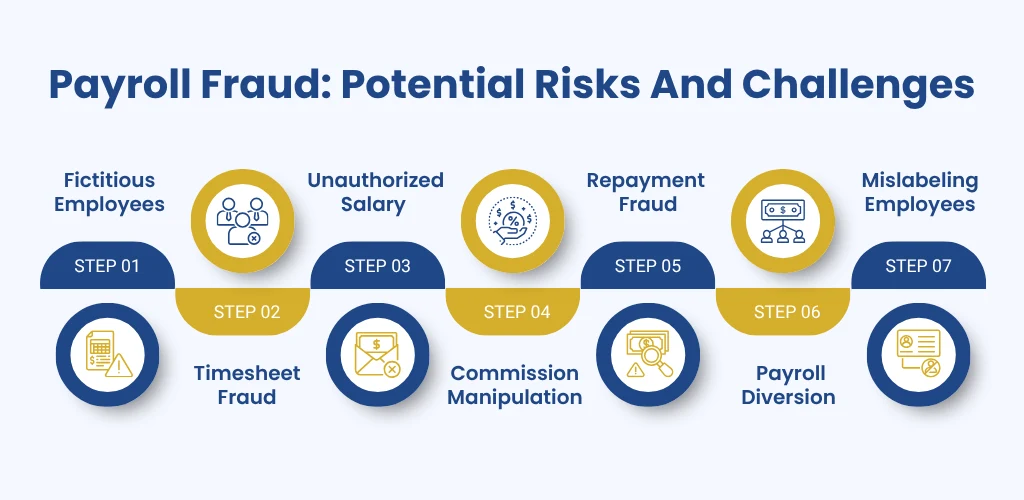
1. Fictitious Employees
Fraud in the payroll system does occur. One of the most popular methods is payroll fraud through “fictitious employees.” This is when fraudulent employees are inserted into the system, typically by someone with Payroll Processing access.
The Fictitious Employee Method:
- The payroll supervisor creates a fictitious employee record.
- Salaries are directly deposited into accounts held by the fraud perpetrator.
Fraud Warning Signs:
- Employees who are missing tax identification numbers or contact information.
- Bank accounts that are duplicated.
- Payroll costs that seem to increase unusually.
2. Timesheet Fraud
Timesheet fraud is when an employee lies about their hours worked to receive more money than they should.
Examples of this behavior are:
- Punching the timecard for a coworker who is not present
- Overtime hours that are not worked.
- Claiming hours that were never worked.
Things to look out for:
- Too much overtime
- Abnormal patterns for clocking in and out
- No supervision to corroborate the time worked.
3. Unauthorized Salary Changes
Employees with access to payroll systems may increase their own salaries or those of accomplices without approval.
How it happens:
- Payroll staff manipulate salary records
- Lack of approval workflows allows unnoticed changes
Red flags:
- Sudden salary increases without documentation
- Discrepancies between HR records and payroll
4. Commission Manipulation
Trades involving sales- or performance-based commissions and involving bonuses can be easily manipulated.
Some such examples include:
- Inflated sales claims
- Incentives not earned being claimed
Some key red flags include
- Discrepancy between reported sales and received incentives
- Manual overrides being applied frequently
5. Repayment Fraud
While reimbursements aren’t exactly part of payroll, they are handled in parallel, and in some cases, together with payroll.
For example:
- Fake receipts
- Claiming personal expenses as business expenses
Warning signs:
- Claiming high-dollar amounts repeatedly
- Submitting the same receipts more than once.
6. Payroll Diversion
In this scheme, criminals reroute employee wages to other bank accounts.
Here’s how it works:
- Phishing attempts are used to obtain employee login information.
- Bank information is altered just prior to payroll processing.
Warning signs:
- New bank account information
- Employees reporting wages that are not received.
7. Mislabeling of Employees
For Employers:
In order to bypass tax obligations and benefits programs, employers may wrongfully classify workers as independent contractors.
Exposure to:
- Legal consequences
- Tax repercussions
- Noncompliance risks
How to Prevent Payroll Fraud
Preventing payroll fraud requires a combination of strong internal controls, technology, and regular monitoring.
1. Establish Robust Internal Controls
- Distribute payroll functions across multiple employees
- Restrict one person from managing the payroll system.
- Implement approval workflows for changes in base salary and bonuses.
2. Perform Continuous Audits
- Regularly conduct internal audits for payroll, at least monthly or quarterly.
- Verify payroll information against HR records.
- Cross-check employee names against bank account information.
An audit is useful for discovering problems before they become serious.
3. Invest in Payroll Software that Has Robust Security Features
Modern payroll systems include
- Access control based on roles
- Trail audits
- Alerts for anomalous activities
Quality software is less likely to have payroll problems and eliminates the possibility of fraud.
4. The Monitoring of Employee Information
- Regularly verify the information of employees.
- Ensure documented information for all employees.
- Remove employees who have been terminated or are inactive in a timely manner.
5. Mandate Approval Processes
Impose a requirement of two approvals for
- Changes in pay
- New employee entries into the system
- Disbursement of bonuses from the company
This provides an additional level of accountability.
6. Staff Awareness
- Train staff on payroll policies and fraud risks
- Encourage reporting of suspicious activities
- Establish a whistleblower policy
Awareness is a powerful tool in fraud prevention.
7. Safeguard Payroll Systems
- Adopt strong passwords with multi-factor authentication.
- Restrict access to sensitive payroll information and systems.
- Regularly update systems to protect against cyber threats.
8. Payroll account reconciliation
- Compare payroll reports to bank documents.
- Take action to understand the differences as soon as they are identified.
- Ensure each payment has the correct authorization.
The Cost of Ignoring Payroll Fraud
The potential ramifications of ignoring payroll fraud include:
- Financial losses
- Legal penalties
- Damage to employee trust
- Reputational harm
A small fraud incident can become a much larger liability as time goes on.
Conclusion
All sizes of companies have to deal with the threat of payroll fraud. The threats are many and diverse but preventable.
Implementing internal controls, using tech, and conducting audits can curb the threat of payroll fraud. Aside from the fact that fraud is more expensive to deal with than prevent, fraud prevention has many cost-saving benefits.
FAQs
1. What is the most common type of payroll fraud?
The most common type is ghost employee fraud, where fake employees are added to the payroll and salaries are diverted.
2. How can small businesses prevent payroll fraud?
Small businesses can prevent fraud by separating duties, using payroll software, and conducting regular audits even if resources are limited.
3. What are the warning signs of payroll fraud?
Common signs include unusual payroll increases, duplicate bank accounts, excessive overtime, and unexplained salary changes.
4. How often should payroll audits be conducted?
It’s recommended to conduct payroll Audits at least quarterly, though monthly reviews provide better control.
5. Can payroll fraud happen in automated systems?
Yes, even automated systems can be exploited if access controls and monitoring are weak.
6. Who is usually responsible for payroll fraud?
It is often committed by employees with access to Payroll systems, such as HR or accounting staff.
7. What tools help in detecting payroll fraud?
Tools like Payroll Software with audit trails, anomaly detection systems, and data analytics can help identify suspicious activities.